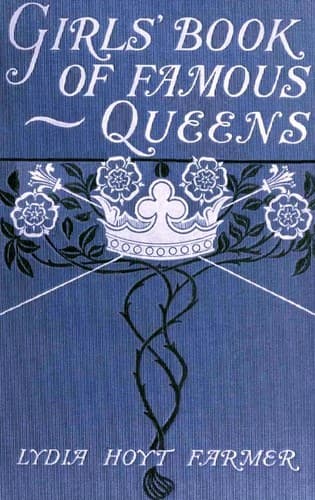
The Girls' Book of Famous QueensFarmer, Lydia Hoyt
History
The Girls' Book of Famous Queens
Farmer, Lydia Hoyt
Queens -- Biography -- Juvenile literature
Some writers do declare, however, that James VI., of Scotland, did make
some feeble efforts in her behalf, which were quickly made unavailing
through the wily cunning of Elizabeth and her scheming ministers.
When her sentence was read to the hapless Queen of Scots, Mary made the
sign of the cross and calmly said “that death was welcome, but that she
had not expected after having being detained twenty years in prison
that her sister Elizabeth would thus dispose of her.” At the same time
Mary placed her hand upon a book beside her, and swore a solemn oath
that she had never contemplated nor sought the death of Elizabeth.
“That is a popish Bible,” exclaimed the Earl of Kent, rudely; “your
oath is of no value.”
“It is a Catholic testament,” said the queen with calm dignity, “and
therefore, my lord, as I believe that to be the true version, my oath
is the more to be relied on.”
Some writers claim that Elizabeth did not herself sign the
death-warrant of Mary, Queen of Scots, but tacitly consenting thereto,
her signature was at last forged by one Thomas Harrison, a private
and confidential secretary of Sir Francis Walsingham. According to
Elizabeth’s secretary, Davison, the warrant had been ready for six
weeks when the queen signed it in private, consigning it to the
Secretary of State, Davison, “without other orders,” as she afterwards
declared. Regarding Harrison’s confession, which did not come to light
until twenty years after Mary’s execution, it is stated that a document
was found, purporting to be a Star-Chamber investigation, dated 1606.
It is a deposition, attested by the signatures of two persons of the
names of Mayer and Macaw, affirming, “that the late Thomas Harrison, a
private and confidential secretary of the late Sir Francis Walsingham,
did voluntarily acknowledge to them that, in conjunction with Thomas
Phillipps and Maude, he, by the direction of his master, Sir Francis
Walsingham, added to the letters of the late queen of Scotland those
passages that were afterwards brought in evidence against her, and for
which she was condemned to suffer death; and that he was employed by
his said master, Sir Francis Walsingham, to forge Queen Elizabeth’s
signature to the death-warrant of the Queen of Scots, which none of her
ministers could ever induce her to sign; and that he did this with the
knowledge and assent of four of her principal ministers of state.”
Regarding this point, Miss Strickland, in her life of Queen Elizabeth,
says: “If she did not sign the warrant for Mary’s execution,—and we
have only Davison’s asseveration in proof that she did,—then was
her ignorance of the consummation real, her tears and lamentations
unaffected, and her indignation against her ministers no grimace.”
Public-domain text, read in full here on John Shaqi.
Reviews
Reviews
No reviews yet
Be the first to share your thoughts on this work.
Elsewhere in the archive
Join the Discussion
Join the discussion
Sign in to leave a comment or review.
Sign InorCreate an account