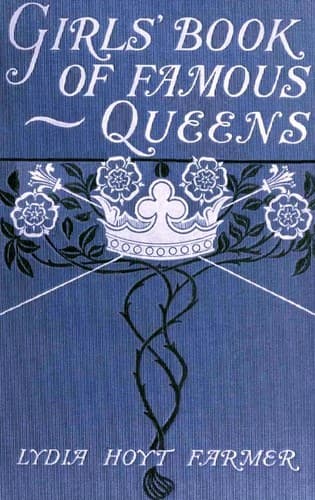
The Girls' Book of Famous QueensFarmer, Lydia Hoyt
History
The Girls' Book of Famous Queens
Farmer, Lydia Hoyt
Queens -- Biography -- Juvenile literature
The tribunal which judged the queen was composed of a president and
four judges, the public prosecutor, Fouquier-Tinville,—a man who even
at that time was notorious as being amongst the most inhuman of the
monsters who then governed revolutionary France,—the chief registrar,
and fifteen jurymen. Fouquier-Tinville had himself drawn out at great
length the act of accusation. He looked upon it as his _chef d’œuvre_,
and Chauveau-Lagarde, the queen’s counsel, did not exaggerate when
he called it a “work of the devil.” In it the queen was compared to
Messalina, Brunehild, Frédégond, and the Medici. He declared that
“since her arrival in France she had been the curse and leech of the
French nation; that she had maintained a secret correspondence with
the king of Bohemia and Hungary; that her aim was the ruin of the
country; that by her instigation, and in concert with the brothers of
Louis XVI. and the infamous Calonne, formerly minister of finance,
she had lavished the wealth of the nation, the spoils of the sweat of
the people, in maintaining her criminal expenditure and in paying the
agents of her treasonable intrigues; that she had sent millions out
of the country to the emperor, in order to maintain the war against
the republic, and that she had thus exhausted the revenues of the
country. Further, that since the commencement of the Revolution she had
not ceased an instant from maintaining a treasonable correspondence
with the enemy, and, by every means in her power, aided and abetted a
counter revolution.” He then went back and harped, at great length,
upon the affair of the Gardes du Corps at Versailles in 1789, and also
on the flight to Varennes; accused her of the loss of life on the 17th
of July, 1792, at the _Champs de Mars_, and declared that owing to her,
and her alone, the massacre occurred at Nancy and elsewhere. “Thus this
man raved on in an endless series of accusations, which seem more as
if they came from the disordered brain of a homicidal maniac than from
a man in his senses.”
Indeed, one can only believe that some of the writings and actions
of the actors in the year of terror, 1793, were owing to a state of
madness. It is said, and on good authority, that Fouquier-Tinville
ultimately confessed to being pursued by horrible visions, saying that
he saw the spirits of those he had condemned to death menacing him, not
in his dreams, like Richard III., but in broad daylight. And well he
might; for between the 10th of March, 1793, and the 27th of July of the
following year, two thousand six hundred and sixty-nine victims were
sent from that tribunal to the guillotine.
Then followed the second day. “What is your name?” inquired one of the
judges.
“Marie Antoinette de Lorraine d’Autriche,” answered the queen.
“What is your condition?” was the next question.
“Widow of Louis, king of France.”
“What is your age?”
“Thirty-eight.”
Public-domain text, read in full here on John Shaqi.
Reviews
Reviews
No reviews yet
Be the first to share your thoughts on this work.
Elsewhere in the archive
Join the Discussion
Join the discussion
Sign in to leave a comment or review.
Sign InorCreate an account