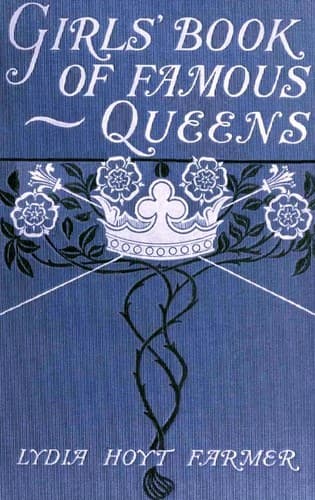
The Girls' Book of Famous QueensFarmer, Lydia Hoyt
History
The Girls' Book of Famous Queens
Farmer, Lydia Hoyt
Queens -- Biography -- Juvenile literature
At length the Persian monarchs conquered the country. About two hundred
and seventy years before the time of Cleopatra, Alexander the Great, in
his wars with Darius, had taken possession of Egypt; and at his death,
in the division of his empire amongst his generals, Egypt fell to the
share of one of them named Ptolemy. This was the commencement of the
dynasty of the Ptolemies, who were Greek princes, reigning over this
Egyptian empire, formerly governed by a long line of native kings,
reaching back in history to the year 3000 B.C., and including the
famous lines of Cheops, Thotmosis, Rameses, and others, known under the
general name of the Pharaohs.
We cannot give any particulars of these reigns in this sketch, and will
only mention some of the customs of the ancient Egyptians previous to
the time of Cleopatra.
Egypt contained about five millions of people, who were divided into
various castes. Plato tells us that in Egypt not only were the priests,
the soldiers, and artisans habitually separated, but that every
particular trade and manufacture was carried on by its own craftsmen,
who handed down the trade from father to son.
The entire cultivated land of Egypt was about twelve millions of acres.
The clothing of the Egyptians consisted mostly of linen, made from
the flax which grew abundantly in the delta of the Nile. Wool was but
little employed, as the soil was not fitted for grazing sheep. Cotton
was first mentioned in the reign of Amasis, about 566 B.C. It was also
this Amasis who allowed his wife, the Egyptian queen, to receive the
large income from the royal fishery at the flood-gates to the lake of
Moeris, to meet the expenses of her toilet; and a century later the
reigning monarch added the taxes of the city of Anthylla to the former
income to keep his queen in sandal-strings; the sum obtained from the
fisheries being a talent a day, or upwards of 70,700 pounds a year:
and when this formed only a portion of the pin-money of the Egyptian
queens, to whom the revenues of the city of Anthylla, famous for its
wines, were also given, it will be seen that the Egyptian kings were at
least very generous to their wives in this respect, even though they
were not very particular about cutting off their heads or giving them a
cup of poison if they failed to please their royal lords.
Although wool and cotton were sometimes employed as articles of
clothing, the preference was given to linen. Herodotus mentions some
Egyptian dresses of linen, bordered with a fringe, over which was worn
a cloak of white wool, similar to the _bornouse_ worn at the present
day in Egypt and Barbary.
Public-domain text, read in full here on John Shaqi.
Reviews
Reviews
No reviews yet
Be the first to share your thoughts on this work.
Join the Discussion
Join the discussion
Sign in to leave a comment or review.
Sign InorCreate an account