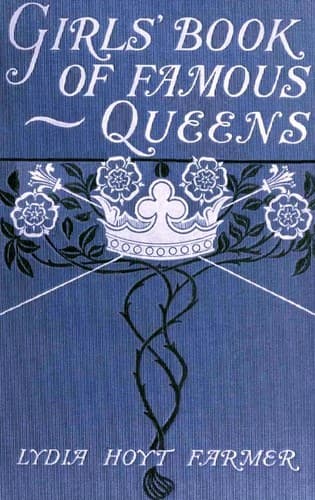
The Girls' Book of Famous QueensFarmer, Lydia Hoyt
History
The Girls' Book of Famous Queens
Farmer, Lydia Hoyt
Queens -- Biography -- Juvenile literature
The dresses of the priests and persons of rank consisted of an
under-garment in the form of an apron, and a loose upper-robe with full
sleeves, secured by a girdle around the waist; or of an apron, and a
shirt with short, tight sleeves, over which was thrown a loose robe,
leaving the right arm exposed. Princes wore a dress very like that of
the priests; but their distinguishing mark was a peculiar badge, at the
side of the head, descending to the shoulder, and frequently adorned
with golden fringe.
This ornament contained the lock of hair indicative of youth; for
though the Egyptians shaved their heads and wore wigs, certain locks of
hair were left upon the heads of children.
Therefore this badge was always attached to the head-dress worn by
princes as an emblem of their rank, as they were not supposed to have
arrived at _kinghood_ during the life of their father, on the same
principle that a Spanish prince is styled an _infant_.
The robes of a sovereign varied according to his present occupation. As
all the kings were also priests, when they were engaged in the office
of high-priest their garments resembled those worn by the sacerdotal
order, with the exception of the apron and head-dress, which were of
peculiar form, and belonged exclusively to the rank of king. This apron
was richly ornamented in front with lions’ heads and other devices, and
bordered with rows of asps, which were the emblems of royalty. After
the union of Lower and Upper Egypt the sovereign wore a double crown.
Egyptian men always shaved the entire head, and wore wigs, both within
the house and out of doors. The women, however, wore their own hair,
and were not shaved even in times of mourning or after death. Ladies
wore their hair long and plaited in a great number of braids. The hair
was plaited in the triple plait, the ends being left loose. Around the
head was bound an ornamental fillet, with a lotus-bud falling over the
forehead. The ear-rings worn by Egyptian ladies were large, round,
single hoops of gold, sometimes over two inches in diameter, or made
of six rings soldered together. Often an asp, whose body was of gold
set with precious stones, was worn by persons of rank. Some few were of
silver. Women wore many rings, sometimes three and four upon the same
finger, and even the thumb was decorated with a single ring. Rings were
ornamented with the scarabæus, or sacred beetle, or an engraved stone.
They were occasionally in the form of a knot, or snail, or snake.
Two cats, with an emblem of the goddess Athor between them, seems to
have been a favorite device for rings. Egyptians also wore large gold
anklets, or bangles, armlets, and bracelets, frequently inlaid with
precious stones. Richly ornamented necklaces were a principal part of
the dress of both men and women.
Public-domain text, read in full here on John Shaqi.
Reviews
Reviews
No reviews yet
Be the first to share your thoughts on this work.
Join the Discussion
Join the discussion
Sign in to leave a comment or review.
Sign InorCreate an account