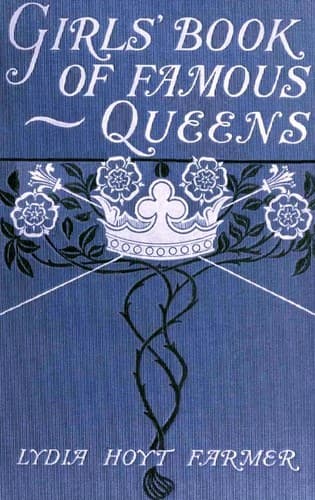
The Girls' Book of Famous QueensFarmer, Lydia Hoyt
History
The Girls' Book of Famous Queens
Farmer, Lydia Hoyt
Queens -- Biography -- Juvenile literature
Some of these bottles are ornamented with the figure of an ape, or
monster, supposed to assist in holding the bottle between his arms
while the fair beauty dipped her dainty bodkin into the much-prized
beautifier. Pins and needles have also been found among the articles
of the toilet. Some of these pins are of gold, and similar in size to
those now employed by ladies as hat-pins and fancy hair-pins. Metal
mirrors are also found richly ornamented and highly polished. It will
be remembered that the brazen laver made by Moses for the tabernacle
was formed of the “looking-glasses of the women,” who doubtless brought
them from Egypt at the time of the exodus of the Israelites. The
Egyptian dandies were also not without the highly prized canes. Many of
these have been found at Thebes; some having a carved lotus-blossom for
the head. It was customary, on entering a house, to leave their canes
or sticks in the hall or at the door; and poor men were often employed
to hold the canes of guests during a party, by the master of the house,
who rewarded them with money or food. We have little knowledge of the
nature of their baths; but as they were forbidden in deep mourning to
indulge in them, they were probably considered a luxury as well as a
necessity. The priests were remarkable for their love of cleanliness,
shaving the whole body every three days, and bathing twice every day
and twice during the night. So great an abhorrence did an Egyptian feel
for an unshaven person, that Herodotus says, “No Egyptian of either sex
would on any account kiss the lips of a Greek, make use of his knife,
his spit and cauldron, or taste the meat of an animal which had been
slaughtered by his hand.”
This shaving of the head among the Egyptians is given as a reason
by Herodotus for the remarkable hardness of the Egyptian sculls, as
compared with those of other people. The most singular custom of the
Egyptians was that of tying a false beard upon the chin, which was
plaited and shaped according to the rank of the person. The beards
on the figures of the gods were distinguished by the turning up of
the ends. No man ventured to assume the beard of a deity. But after
death, kings were accorded the honor of having their statues thus
distinguished.
The art of painting common boards to imitate costly varieties, now so
often employed, was practised by the ancient Egyptians. Boxes, chairs,
tables, sofas, and other pieces of furniture were frequently made of
ebony inlaid with ivory, and articles of sycamore and acacia were
ornamented with rare woods.
Public-domain text, read in full here on John Shaqi.
Reviews
Reviews
No reviews yet
Be the first to share your thoughts on this work.
Join the Discussion
Join the discussion
Sign in to leave a comment or review.
Sign InorCreate an account