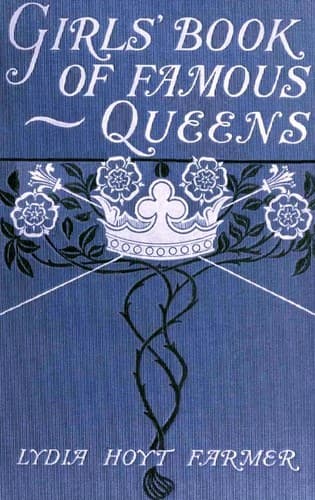
The Girls' Book of Famous QueensFarmer, Lydia Hoyt
History
The Girls' Book of Famous Queens
Farmer, Lydia Hoyt
Queens -- Biography -- Juvenile literature
The Egyptians displayed much taste in their gold, silver, porcelain,
and glass vases. Glass was known from the earliest times, and
glass-blowing was employed by them twenty-five hundred years ago. It is
also stated that their dead were sometimes enclosed in glass coffins,
or a crystal sarcophagus was made by covering the granite with a
coating of vitrified matter, usually of a deep green color, which by
its transparency allowed the hieroglyphics engraved upon the stone
beneath to be plainly visible.
Emeralds, rubies, amethysts, and other expensive gems were most
successfully imitated by the jewellers of Thebes. Pliny states that
glass-cutting was known to the ancients, and that the diamond was
employed for that purpose, as at present, even if they were ignorant of
the art of cutting the diamond itself with its own dust. “Diamonds,”
says Pliny, “are eagerly sought by lapidaries who set them in iron
handles, for they have the power of penetrating anything, however hard
it may be.”
The art of embroidery was commonly practised in Egypt, and gold and
silver threads were used for this purpose. The loom was also employed
by them, both in weaving linen, cotton, and wool, and also for the
production of very rich stuffs, in which various colors were worked in
innumerable patterns by the loom.
The Egyptians were also famed for their manufacture of paper, which
was in the form of parchments made from the plant papyrus, which grew
in the marshy regions of the Nile in great profusion. Leather was also
prepared by them with great skill for various purposes, and the knife
employed by them in the process, between three and four thousand years
ago, is precisely similar to that used by modern curriers. Fullers,
potters, carpenters, and cabinet-makers formed a large class of
Egyptian workmen. The Egyptians were skilled in the working of metals;
and gold, silver, brass, tin, iron, and lead were known in those days.
The art of embalming the dead was practised by the Egyptians with a
perfection never since equalled.
Egyptian paintings were very primitive, and their sculptures were more
remarkable for huge grotesqueness than any perfection of art, as their
artists were limited to such a conventional mode of drawing. After
the accession of the Ptolemies, Greek art became well known in Egypt,
but their artists still continued to adhere to the Egyptian models
prescribed.
The Egyptians appear to have possessed some secret for hardening
or tempering bronze, with which we are totally ignorant; for the
wonderful skill with which they engraved their granite obelisks with
hieroglyphics, for which purpose they used implements of bronze, cannot
be equalled by any process in modern times.
The walls and ceilings of the houses of the Egyptians of high rank were
richly painted, as well as their tombs. The ceilings were laid out in
compartments, each having peculiar pattern and border. The favorite
forms were the lotus, the square, the diamond, and the succession of
scrolls.
Public-domain text, read in full here on John Shaqi.
Reviews
Reviews
No reviews yet
Be the first to share your thoughts on this work.
Join the Discussion
Join the discussion
Sign in to leave a comment or review.
Sign InorCreate an account