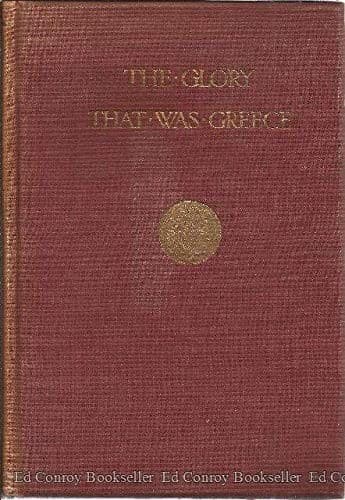
The Glory That Was Greece: a survey of Hellenic culture and civilisationStobart, J. C. (John Clarke)
History
The Glory That Was Greece: a survey of Hellenic culture and civilisation
Stobart, J. C. (John Clarke)
Art, Greek; Greece -- Civilization -- To 146 B.C.
In poetry Alexandria is connected with some important developments,
chiefly literary revivals of ancient modes. Thus Apollonius the Rhodian
attempted to revive the epic, and wrote a long poem in hexameter verse
on the Argonautic expedition of Jason. It is of course rather cold and
formal, it is a long way from Homer, but it is of considerable merit in
the field of poetry. Alexandria revived also the elegiac couplet,
chiefly for short epigrams, some of which have the beauty and colour of
a Greek gem. We may see for an example that epigram of Callimachus from
which I have taken the couplet at the head of my Introduction, and which
was so charmingly translated by William Johnson Cory. I quote another
elegiac epigram of Meleager’s to show how modern in tone and subject
these dainty lyrics had become in the first century B.C.:
“Poor foolish heart, I cried ‘Beware,’
I vowed thou wouldst be captured,
So fondly hovering round the snare,
With thy false love enraptured.
“I cried, and thou art caught at last,
All vainly flutterest in the toils.
Lord Love himself hath bound thee fast
And meshed thy pinions in his coils.
“And he hath set thee on his fire,
In drugs thy swooning soul immersed,
In stifling perfumes of desire,
With scalding tears to quench thy thirst.”
So far it is mainly a record of revivals, but in Theocritus, who, though
Sicilian by birth, passed most of his active career at Alexandria, we
have the inventor of a new and most important branch of literature. With
him pastoral poetry was a fresh and genuine creation. His Idylls are, as
their name implies, a series of cameo pictures of shepherd life in
Sicily. We have found no space here to speak of the later developments
of Sicilian history, which in the fourth and third centuries became
once more a desperate battleground between Carthaginian invaders and
clever Syracusan tyrants like Dionysius and Agathocles. It is strange to
think that the beautiful rustic life depicted by Theocritus could exist
among the hills and glens of Sicily in spite of all the turmoil of
history. Mr. Andrew Lang has completely vindicated Theocritus from the
charge of artificiality by pointing out that the shepherds of modern
Greece sing in language of refined and impassioned poetry that is
perfectly natural and spontaneous. Large parts of the Idylls sound like
quotations of such songs of Nature. Theocritus was, of course, the
source of that pastoral convention which has produced so much that is
artificial in art and literature amid much of supreme beauty. We think
at once of Vergil, Spenser, Sidney, Milton, Watteau, and the Dresden
shepherdess. Theocritus is the literary father of all these. In his
famous Fifteenth Idyll, which describes with exquisite humour the
conversation of a pair of Sicilian dames going to see a festival of
Adonis at Alexandria, we have the beginnings of another literary
form--the mime.
Public-domain text, read in full here on John Shaqi.
Reviews
Reviews
No reviews yet
Be the first to share your thoughts on this work.
Elsewhere in the archive
Join the Discussion
Join the discussion
Sign in to leave a comment or review.
Sign InorCreate an account