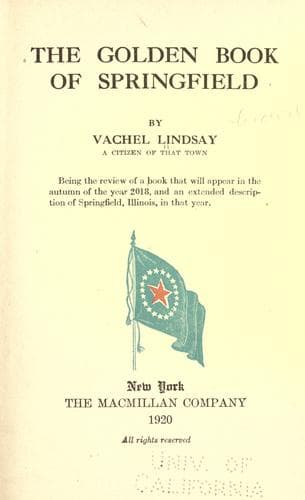
Springfield (Ill.) -- Fiction; Springfield (Ill.) -- In literature; Utopias in literature
Few of Campbell’s older followers dwell on the hope of a practical City
of God that shouted from the covers even before they were opened. This
reasonable, non-miraculous millennium is much in the mind of my
neighbor, and he tells me again and again of a vision that he has of
Springfield a hundred years hence. But more of this later.
There is a woman who is florist of our town, Anne Morrison a descendant
of the Chapman family. She holds in special reverence, John Chapman,
(Johnny Appleseed,) who began his labors in a region a little north of
Alexander Campbell’s diocese, in the Ohio basin. He remains a tradition
among the more northern group of those who worshipped Campbell, and
among similar pioneers. He is especially honored by that splendid sect,
the Swedenborgians, for he was a preacher and teacher of the doctrines
of Swedenborg. But he was even more notably a nurseryman. He was
deserving of the laurels of Thoreau, three times and more, and by the
test of life rather than writing, to him belongs nearly every
worth-while crown of Whitman. He skirmished on the very edge of the
frontier, but fought the wilderness, not the Indian. The aborigines
thought him a great medicine man and holy man, because of his magical
bag of seeds, for along their trails, wherever he tramped, there soon
came up pennyroyal and all beneficent herbs. With the tenderness of St.
Francis he wept over every wounded bird, and with the steadiness of a
nation builder, he planted orchards of apples in the openings of the
forest, fenced them in, and left them for the pioneers to find, long
after. He wore for a shirt and sole article of clothing an old
gunny-sack with holes cut for arms and legs, and winter or summer slept
in the hollow tree on the pile of old leaves, and weathered it past
seventy years, while the great Whitman lived in houses, and Thoreau was
on Walden but a season or two. These men left behind them certain
writings, but Johnny Appleseed left behind him apples, orchards heavy
with fruit, beauty from the very black earth, and a tradition whose
wonder shall yet ring through all the palaces of mankind. He was swift
as the deer, and gentle as the fawn,—and stern with himself, as the Red
Indian. Like Christ and Socrates he wrote only in the soil. He was
welcomed more like an angel than a man in the pioneer cabins, and if
ever there was an American saint left uncanonized in 1920, it is John
Chapman, Johnny Appleseed, and by 2018 he is canonized indeed, and has
his niche in the Springfield Cathedral, according to Anne Morrison’s
revelation.
Public-domain text, read in full here on John Shaqi.
Reviews
Reviews
No reviews yet
Be the first to share your thoughts on this work.
Join the Discussion
Join the discussion
Sign in to leave a comment or review.
Sign InorCreate an account