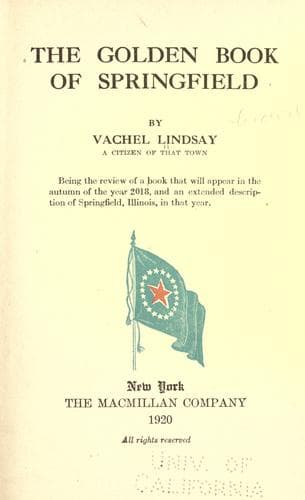
Springfield (Ill.) -- Fiction; Springfield (Ill.) -- In literature; Utopias in literature
Ultra modern followers of Campbell hang in their libraries with
unlimited pride a certain Rembrandtesque lithograph of the great man, an
heirloom that is now quite rare, and to be classed in its southern way,
as the spinning wheels and old Bibles of the Mayflower are classed in a
northern way. This lithograph is the enlargement of the engraving in the
front of the Richardson biography, but much color and magic have been
added. Out of the darkness emerges a smooth-shaven, high bred, masterful
physiognomy more like that of the statesmen who were the fathers of the
republic, than of a member of any priesthood. Campbell’s cheeks and eyes
are still fired with youth and authority militant. He has a head bowed
with thought, crowned with grey hair, and beneath his chin is the most
statesmanlike of cravats, with a peculiarly old-fashioned roll. Thus he
must have looked, at the height of debate with the infidel.
This is the man who put so much learning, and deathless controversy, and
high distinction into the log cabins of the Ohio river basin, especially
the romantic regions of Mason and Dixon’s line. On west of the
Mississippi his followers carried his light to Seattle, Portland, and
Los Angeles, and the cities of Alaska and Canada and the farms between.
And they start ’round the world with it all over again at this hour. Yet
in the end that light is apt to have a color of its origin, touched with
Virginia, West Virginia, and Kentucky;—a southern gospel, far indeed
from Plymouth Rock, or Manhattan Island.
I can never forget the copy of the lithograph that hung over my
grandmother’s front room fireplace in the patriarchal Frazee farm house
in Indiana. Under it I heard proverbs from Campbell every summer, from
the time I can remember anything. All those sayings were mixed up with
stories that came with my people along the old Daniel Boone trail from
Kentucky and Virginia. And when that old frame house was new and novel,
and most other dwelling houses near were log cabins, Campbell had been a
guest received with breathless reverence. Under that picture I was
personally conducted through all the daguerreotypes and records
pertaining to the Kentucky pioneers of our blood.
And now, in Springfield, under the same rich lithograph my neighbor
keeps the bound volumes of Campbell’s _Christian Baptist_ and _Millenial
Harbinger_, once the arsenal of every debating “elder” of our
persuasion. My grandfather’s copies were marked, every page, and these
are marked by my radical friend, but with a different point of view.
On a certain evening I am in the pastor’s study tracing with
astonishment the suggestion of Christian Socialism in the first number
of the _Harbinger_. My Grandma had said nothing about _that_!
Public-domain text, read in full here on John Shaqi.
Reviews
Reviews
No reviews yet
Be the first to share your thoughts on this work.
Join the Discussion
Join the discussion
Sign in to leave a comment or review.
Sign InorCreate an account