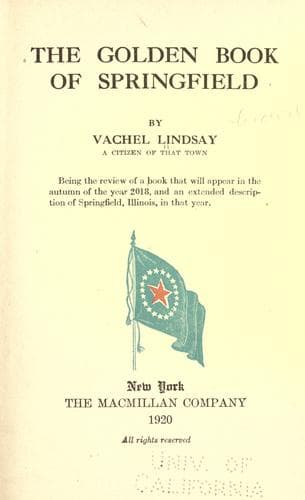
Springfield (Ill.) -- Fiction; Springfield (Ill.) -- In literature; Utopias in literature
All this point of view is in my friend’s tone of voice and gesture. He
has inherited part of his money, and married the rest, and the income
pays for a good caretaker. He himself is a physician for the most
extensively landed families in central Illinois. He dresses well, so
people think he knows all about medicine. He is squarely set, has a
heavy jaw, a steadying manner, a kindly disposition, pays the best
salaries to his office boy and secretaries and the people who work his
farms. He has the greatest aversion to oaths, bad manners, adultery, and
has a literary turn. Though he looks like an old prize fighter with a
touch of deacon-sleekness, he reads Montaigne, Lord Chesterfield,
Thackeray, Shakespeare, and the like. He enjoys discussing in the most
sympathetic way every human trait that has to do with purely domestic
dramatic and personal emotions. His wife is a valiant Daughter of the
American Revolution and his daughter belongs to the most snobbish
sorority to be discovered for miles. He has been “right in the wagon”
whenever a bit of near royalty has passed through Springfield, and his
manner though blunt, was deferential. His wildest turn is for radical
painters, and he has the best collection west of the Hudson of the now
forgotten cubists.
Of far different sort is the next member of our Club. She is of the fine
nerved creatures of this world, a spring beauty in whose conversation I
take delight. She is a teacher in one of the Springfield ward schools,
and a sober little reader of _The Atlantic Monthly_, and we quarrel a
bit about that. But her taste there represents her desire for fine
grained English whatever the thought conveyed. When Clara Horton takes
delight in life, it comes in a flash that sets her friends aflame. The
school marm is gone. She ceases to admonish me. The imaginary eyes of
her censorious pupils are banished, and I am no longer a pupil, and she
is the daughter of a nymph of the most delicate mood and a faun of the
gentlest sort. Her whole physical fabric is aglow with the idea of the
book or the event or the mere day’s sunshine or tomorrow’s movie. Her
skin shows the whiteness of a stock that has been too inbred for many
generations for complete vigor, the gentle nymph and the gentle faun met
too often, and there were not quite enough bullies or peasants among her
far European ancestors. Her people have been for many generations in
America. Every line of her family, north and south, has been remembered
with the greatest comprehension of every taste and impulse. She gets her
silky black hair from one grandmother, and her thousand dimples from
another no doubt. She openly hates the complacency of our “first
families.” Ideas go pouring through her head, all the time.
Public-domain text, read in full here on John Shaqi.
Reviews
Reviews
No reviews yet
Be the first to share your thoughts on this work.
Join the Discussion
Join the discussion
Sign in to leave a comment or review.
Sign InorCreate an account