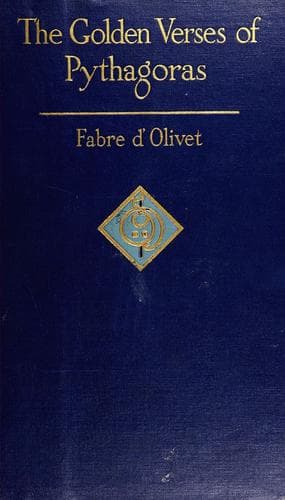
The golden verses of PythagorasFabre d'Olivet, Antoine
Religion
The golden verses of Pythagoras
Fabre d'Olivet, Antoine
Poetry -- History and criticism; Pythagoras and Pythagorean school
I can say, after having repeated this observation, that the poet
Linus, who is regarded as the author of all the melancholy chants of
the ancient world, represents nothing less than lunar poetry detached
from the doctrine of Œtolinos, of which I have spoken, and considered
as schismatic by the Thracians; I can also say, that the poet Amphion,
whose chants were, on the contrary, so powerful and so virile,
typifies the orthodox solar poetry, opposed by these same Thracians;
whereas the prophet Thamyris, who, it is said, celebrated in such
stately verse the creation of the world and the war of the Titans,[34]
represents quite plainly the universal doctrine of Olen,
re-established by his followers. The name of Amphion signifies the
orthodox or national voice of Greece; that of Thamyris, the twin
lights of the gods.[35] One feels, accordingly, that the evils which
came to Linus and to Thamyris, one of whom was killed by Hercules,[36]
and the other deprived of sight by the Muses,[37] are, in reality,
only some sort of criticism or unfortunate incident sustained by the
doctrines which they represented, on account of the opposition of the
Thracians. What I have said concerning Linus, Amphion, and Thamyris,
can be applied to the greater part of the poets who preceded Homer,
and Fabricius names seventy of these[38]; one could also extend it to
Orpheus, but only on a certain side; for although it may be very true,
that no positive detail is possessed regarding the character of the
celebrated man, founder or propagator of the doctrine which has borne
this name; although it may be very true, that all that concerns his
birth, his life, and his death is completely unknown, it is none the
less certain that this man has existed, that he has been actually the
head of a very extended sect, and that the allegorical fables which
remain to us on this subject depict, more particularly than they have
done with any other, the course of his thoughts and the success of his
institutions.
Orpheus belongs, on the one side, to anterior times, and on the other,
to times merely ancient. The epoch when he appeared is the line of
demarcation between pure allegory and mixed allegory, the intelligible
and the sentient. He taught how to ally the rational faculty with the
imaginative faculty. The science which was a long time after called
_philosophy_, originated with him. He laid its first basis.
Public-domain text, read in full here on John Shaqi.
Reviews
Reviews
No reviews yet
Be the first to share your thoughts on this work.
Join the Discussion
Join the discussion
Sign in to leave a comment or review.
Sign InorCreate an account