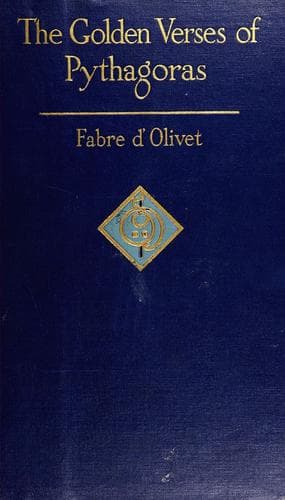
The golden verses of PythagorasFabre d'Olivet, Antoine
Religion
The golden verses of Pythagoras
Fabre d'Olivet, Antoine
Poetry -- History and criticism; Pythagoras and Pythagorean school
Here, said Hierocles, in terminating his commentaries, is the blissful
end of all efforts: here, according to Plato, is the hope which
enkindles, which sustains the ardour of him who fights in the career
of virtue: here, the inestimable prize which awaits him.[671] It was
the great object of the mysteries, and so to speak, the great work of
initiation.[672] The initiate, said Sophocles, is not only happy
during his life, but even after his death he can promise himself an
eternal felicity.[673] His soul purified by virtue, said Pindar,
unfolds in those blessed regions where reigns an eternal
springtime.[674] It goes on, said Socrates, attracted by the celestial
element which has the greatest affinity with its nature, to become
united with the immortal Gods and to share their glory and their
immortality.[675] This deification was, according to Pythagoras, the
work of divine love; it was reserved for him who had acquired truth
through his intellectual faculties, virtue through his animistic
faculties, and purity through his instinctive faculties. This purity,
after the end of his material body, shone forth and made itself known
in the form of a luminous body, that the soul had been given during
its confinement in its gloomy body; for as I finish these
Examinations, I am seizing the only occasion which may still be
presented of saying that, this philosopher taught that the soul has a
body which is given according to his good or bad nature, by the inner
labour of his faculties. He called this body the subtle chariot of the
soul, and said that the mortal body is only the gross exterior. He
adds, “The care of the soul and its luminous body is, in practicing
virtue, in embracing truth and abstaining from all impure
things.”[676]
This is the veritable aim of the symbolic abstinences that he
prescribes, even as Lysis insinuates moreover quite clearly in the
lines which make the subject of my preceding Examination, when he said
that it is necessary to abstain from the things which are injurious to
the development of the soul and to distinguish clearly these things.
Public-domain text, read in full here on John Shaqi.
Reviews
Reviews
No reviews yet
Be the first to share your thoughts on this work.
Elsewhere in the archive
Join the Discussion
Join the discussion
Sign in to leave a comment or review.
Sign InorCreate an account