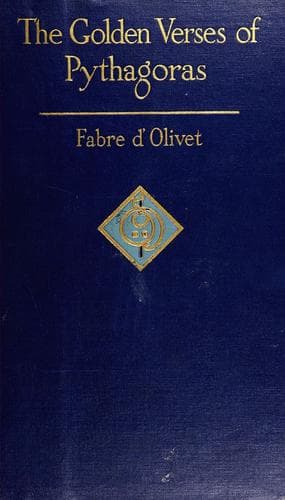
The golden verses of PythagorasFabre d'Olivet, Antoine
Religion
The golden verses of Pythagoras
Fabre d'Olivet, Antoine
Poetry -- History and criticism; Pythagoras and Pythagorean school
Furthermore, Pythagoras believed that there existed celestial goodness
proportionate to each degree of virtue, and that there is for the
souls, different ranks according to the luminous body with which they
are clothed. The supreme happiness, according to him, belongs only to
the soul which has learned how to recover itself, by its intimate
union with the intelligence, whose essence, changing its nature, has
become entirely spiritual. It is necessary that this soul be raised to
the knowledge of universal truths, and that it should have found, as
far as it is possible for it, the Principle and the end of all things.
Then having attained to this high degree of perfection, being drawn
into this immutable region whose ethereal element is no more subjected
to the descending movement of generation, it can be united by its
knowledge to the Universal All, and reflect in all its being the
ineffable light with which the Being of beings, God Himself, fills
unceasingly the Immensity.
FOOTNOTES:
[1] Addressé à la Classe de la Langue et de la Littérature
françaises, et à celle d’Histoire et de Littérature ancienne
de l’Institut impérial de France.
[2] This expression will be explained in the progress of the
discourse.
[3] _De Dignit. et Increment. Scient._, l. ii., c. 13.
[4] _Ibid._, l. ii., c. 1.
[5] _Ibid._, l. vi., c. 1.
[6] Plat., _Dial. Ion._ Aristotle, who was often opposed to
Plato, did not dare to be on this point. He agrees that
verse alone does not constitute poetry, and that the History
of Herodotus, put into verse, would never be other than
history.
[7] _Ibid._
[8] _De Dignit. et Increment. Scient._, l. ii., c. 13.
[9] Leclerc, known by the multitude of his works; l’abbé
Bannier, Warburton, etc.
[10] _De Dignit. et Increment. Scient._, l. ii., c. 13.
Court de Gébelin cites Chancellor Bacon as one of the first
defenders of allegory. (_Génie allég._)
[11] Pausanias, l. iii., p. 93.
[12] Acron, _In Epist. Horat._, i., 2. Certain authors say
that Penelope had conceived this son when Mercury disguised
as a goat had forced her virginity. (Lucian, _Dialog.
Deor._, t. i., p. 176.)
[13] Héraclides, entre les petits mythologues.
[14] _Geogr._, l. i.
[15] _Antiq. rom._, l. ii.
[16] In his book entitled Περὶ τῆς τῶν θεῶν φύσεως, ch. 17.
[17] In his book entitled Περὶ θεῶν καὶ κόσμον, ch. 3. Court
de Gébelin cites these works. (_Génie allég._)
[18] _Præp. Evang._, l. iii., c. 1.
[19] Court de Gébelin, _Génie allég._, p. 149.
[20] Strabo positively assures it. See Bannier, _Mythol._,
ii., p. 252.
[21] Bailly, _Essai sur les Fables_, ch. 14. Pausanias, l.
ix., p. 302.
Public-domain text, read in full here on John Shaqi.
Reviews
Reviews
No reviews yet
Be the first to share your thoughts on this work.
Elsewhere in the archive
Join the Discussion
Join the discussion
Sign in to leave a comment or review.
Sign InorCreate an account