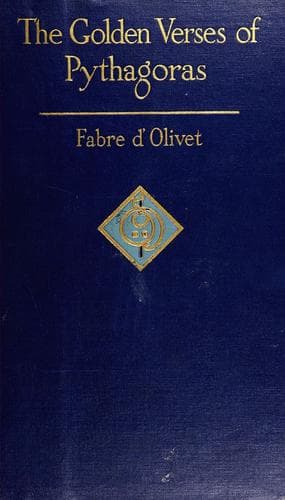
The golden verses of PythagorasFabre d'Olivet, Antoine
Religion
The golden verses of Pythagoras
Fabre d'Olivet, Antoine
Poetry -- History and criticism; Pythagoras and Pythagorean school
[325] Senec., _Epist._, 88; Sext. Empir., _Adv. Math._, l.
vii., c. 2; Arist., _Métaphys._, l. iii., c. 4.
[326] Arist., _Physic._, l. vi., c. 9; _voyez_ Bayle, _Dict.
crit._, art. ZENON, rem. F.
[327] Cicér., _de Natur. Deor._, l. i., c. 15.
[328] _Semel jussit, semper paret_, Seneca has said. “The
laws which God has prescribed for Himself,” he adds, “He
will never revoke, because they have been dictated by His
own perfections; and that the same plan, the same design
having pleased Him once, pleases Him eternally” (Senec.,
_Præf. ad Quæst. nat._).
[329] Cicer., _De Fato_, cap. 17.
[330] Cicer., _ibid._, c. 9.
[331] Aul. Gell., l. vi., c. 2.
[332] Cicer., _De Nat. Deor._, l. i., c. 9; Plutar., _De
repug. Stoïc._; Diogenian. _Apud._; Euseb., _Præp. Evang._,
l. vi., c. 8.
[333] Herodot., _Euterp._, § 171; Julian Firm., _De Error,
prof._, p. 45.
[334] Meurs., _Græc. Feriat._, l. i.; Plutar., _In
Alcibiad._; Porphyr., _De Abst._, l. ii., § 36; Euseb.,
_Præp. Evang._, l. i., c. 1; Schol. Apoll., l. i., v. 917;
Pausan., _Corinth_, p. 73.
[335] Porphyr., _Vitâ Pythag._, p. 10.
[336] The doctrine of Krishna is found especially recorded
in the _Bhaghavad Gita_, one of the Pouranas most esteemed
by the Brahmans; in the _Zend-Avesta_ and in the
_Boun-Dehesh_, that of Zoroaster. The Chinese have the
_Tchun-Tsieou_ of Kong-Tse, historic monument raised to the
glory of Providence; in the _Pœmander_ and _Æsculapius_, the
ideas of Thoth. The book of Synesius upon Providence
contains the dogmas of the Mysteries. Finally one can
consult in the course of the _Edda_, the sublime discourse
of Odin, entitled _Havamâl_. The basis of all these works is
the same.
[337] This, as I observed in my Second Examination, should
be understood only by the vulgar. The savant and the
initiate easily restored to Unity this infinity of gods, and
understood or sought the origin of evil, without the
knowledge of which, divine Unity is inexplicable.
[338] Talès, cité par Platon, _De Republ._, l. x.; Aristot.,
_Metaph._, l. iii.; Cicer., _Acad. Quæst._, iv., c. 37.
[339] Anaximandre, cité par Aristot., _Phys._, l. i.; Sext.
Empir., _Pyrr._, iii.
[340] Anaximène, cité par Arist., _Metaph._, l. i., c. 3;
Plutar., _De Placit. Phil._, i., 3.
[341] Héraclite, cité par Platon, _Theætet._; Arist.,
_Metaph._, l. i., c. 6; Sext. Empir., _Adv. Math._, l. vii.
[342] De Gérando, _Hist. des Syst. de Phil._, t. iii., p.
283; Arist., _Metaph._, l. i., c. 6; Diog. Laërt., l. ix.,
c. 19.
[343] Cicer., _De Nat. Deor._, l. i., c. 9.
[344] Boët., _De Consol._, l. i., prosa 4.
[345] Plutar., _Adv. Stoïc._, p. 1075.
[346] Cicer., _De Fato_, c. 10; Lucret., l. ii., v. 216,
251, 284.
Public-domain text, read in full here on John Shaqi.
Reviews
Reviews
No reviews yet
Be the first to share your thoughts on this work.
Elsewhere in the archive
Join the Discussion
Join the discussion
Sign in to leave a comment or review.
Sign InorCreate an account