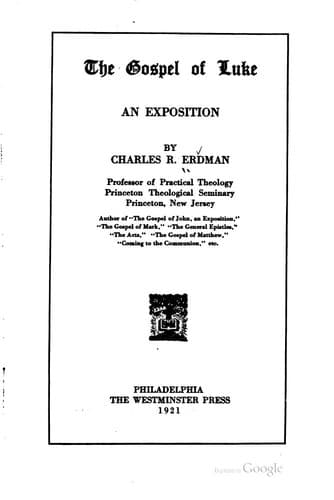
The Gospel of Luke, an expositionErdman, Charles Rosenbury
Religion
The Gospel of Luke, an exposition
Erdman, Charles Rosenbury
Bible. Luke -- Commentaries
Twice each year Zacharias went to Jerusalem to perform for a week his
sacred tasks. Finally there came to him a privilege which a priest could
enjoy only once in his lifetime; the “lot” fell upon him, and he thus was
chosen to enter the Holy Place at the hour of prayer and there offer
incense upon the golden altar just before the veil in the very presence of
God. It was the supreme hour of his life. As the cloud of perfume began to
rise, true symbol of accepted petitions, an angel appeared and assured the
startled priest that his supplications had been heard. For what had
Zacharias then been praying—for a son, or for the salvation of his people?
Were not both desires included in that supplication? As the representative
of a nation, the priest hardly could have confined his petition to what
was purely personal and private. Yet, as he pleaded for the coming of the
Messiah, there must have been in his soul the secret yearning of the long
years or the memory of that abandoned hope which he had always associated
in thought with the salvation of Israel. Many a minister of Christ has a
similar experience; in the very performance of his public tasks there
rests on his soul the conscious shadow of some private grief.
The angel declared that the prayer for national salvation had been heard,
and he gradually unfolded the contents of the divine answer; the Messiah
was about to appear, and his coming was to be heralded by a son who was to
be born to the aged priest. The angel spoke with great definiteness: the
child would be named John; many would rejoice at his birth; he would be a
Nazirite, and as such would take the vow of total abstinence from wine and
of complete dedication to God; as a consequence of this dedication he
would be filled with the divine Spirit and thus enabled to lead his people
to repentance. He would labor in the spirit and power of Elijah, calling
men to lives of natural affection and justice and preparing them for the
salvation which Christ would bring.
So surprising a message was too great to be credited at once by the
wondering priest. He had ceased to hope that the longing of his heart
could be fulfilled. He therefore asked for a sign by which he might be
assured that the blessed promise was true. The angel replied with a
statement of his own majestic power and the glory of his mission and he
granted to Zacharias a sign. This sign was at once a rebuke and a
blessing. It rebuked the unbelief of the aged priest, yet it strengthened
his faith. He was smitten with dumbness which was to continue until the
promise of the angel had been realized. Zacharias would not accept the
word of the Lord; he would not praise him for his goodness and his grace.
Therefore, his tongue was to be silent and he was to be unable to speak
until at last his lips were opened in glad thanksgiving. Unbelief is never
joyous; infidelity has no songs.
Public-domain text, read in full here on John Shaqi.
Reviews
Reviews
No reviews yet
Be the first to share your thoughts on this work.
Join the Discussion
Join the discussion
Sign in to leave a comment or review.
Sign InorCreate an account