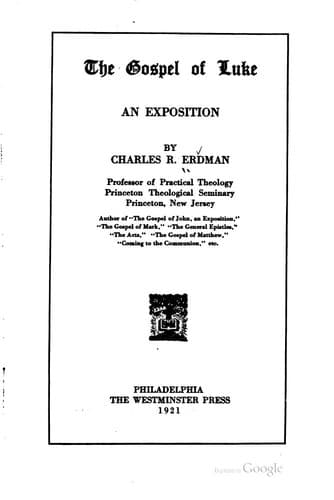
The Gospel of Luke, an expositionErdman, Charles Rosenbury
Religion
The Gospel of Luke, an exposition
Erdman, Charles Rosenbury
Bible. Luke -- Commentaries
21 And the
people were waiting for Zacharias, and they marvelled while he
tarried in the temple. 22 And when he came out, he could not speak
unto them: and they perceived that he had seen a vision in the
temple: and he continued making signs unto them, and remained
dumb. 23 And it came to pass, when the days of his ministration
were fulfilled, he departed unto his house.
24 And after these days Elisabeth his wife conceived; and she hid
herself five months, saying, 25 Thus hath the Lord done unto me in
the days wherein he looked upon _me_, to take away my reproach
among men.
Luke is the gospel of gladness, of praise, and of prayer, of tender, human
interest, and of heavenly grace. It is fitting, therefore, that the
narrative should open with a scene in the Temple at the hour of incense
and with a divine promise which fills a heart with rapturous joy. This
promise concerns the birth of one who is to prepare the way for the
ministry of Christ, and this ministry forms the sum and substance of the
gospel story.
The time was “in the days of Herod,” called “the Great,” a monster of
cruelty, a vassal of Rome, who ruled the Jews with savage tyranny. The
political slavery of the people was only less pitiful than their spiritual
decline, for religion had become an empty form, a mere system of
ceremonies and rites. However, God is never without his witnesses and his
true worshipers. Among these were “a certain priest named Zacharias” and
his wife Elisabeth, who lived in the hill country of Judea, south of
Jerusalem. They “were both righteous before God,” not sinless but without
reproach, carefully observing the moral and also the ritual requirements
of the law. Yet godliness is no guarantee against sorrow or against the
disappointment of human hopes, and these pious souls were saddened because
their home was childless. This trial was peculiarly great among a people
who regarded childlessness as a sign of divine displeasure and it was even
more distressing to the hearts of the faithful who were yearning for the
birth of the promised Messiah.
Public-domain text, read in full here on John Shaqi.
Reviews
Reviews
No reviews yet
Be the first to share your thoughts on this work.
Join the Discussion
Join the discussion
Sign in to leave a comment or review.
Sign InorCreate an account