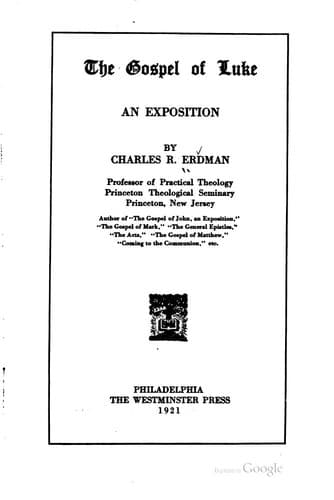
The Gospel of Luke, an expositionErdman, Charles Rosenbury
Religion
The Gospel of Luke, an exposition
Erdman, Charles Rosenbury
Bible. Luke -- Commentaries
When the guests were seated and Jesus saw how they chose for themselves
the most desirable places, he took occasion to rebuke selfish ambition and
to give a lesson in humility. Evidently, when Jesus advised a guest to
“sit down in the lowest place; that when he that hath bidden thee cometh,
he may say to thee, Friend, go up higher,” he was not merely teaching good
manners or worldly wisdom, nor was he advising the pride that masquerades
as humility. He was stating the great law that among his followers true
lowliness and conscious unworthiness in the sight of God are the real
conditions of advancement and honor; “For every one that exalteth himself
shall be humbled; and he that humbleth himself shall be exalted.”
Then as Jesus looked around upon the company he took occasion to teach a
lesson in true charity. He told his host—and there was something of
playfulness in his voice—that in selecting guests one should invite not
only the rich, lest he might be so unfortunate (?) as to receive an
invitation in return, but also the poor, who could not return the favor.
Here again, Jesus was not giving merely rules of social hospitality; he
was illustrating the great spiritual principle of unselfish motives in all
deeds of kindness. We are not to confer benefits with a view to receiving
benefits in return.
However, Jesus did not mean literally to forbid inviting rich guests to
our homes or to insist that all feasts must be confined to paupers, but to
teach that no service is to be rendered with the mere hope of personal
gain. It is proper and pleasant, it may be even profitable, to entertain
“friends” or “brethren” or “kinsmen” or “rich neighbors;” but in none of
these cases is such entertainment a ground of merit for they may “bid thee
again;” but if kindness is shown to the poor or rich simply for their good
and with no thought of personal gain either present or future, the deed
will not be without its reward: “for thou shalt be recompensed in the
resurrection of the just.”
Possibly this reference or some similar reference called forth from one of
the guests the exclamation, “Blessed is he that shall eat bread in the
kingdom of God.” Jesus took the occasion to give the parable of the Great
Supper, by which he illustrated the sinful folly of refusing to accept his
offer of salvation. In this story those who were bidden to the feast at
first feigned a willingness to come, but subsequently, by their refusal
and their flimsy excuses, they showed their complete absorption in selfish
interests and their utter disregard for their host. However, their places
were filled with other guests, some of them poor and helpless, from their
own city; others were vagrants from the highways and hedges beyond. Thus
Jesus plainly pictured the refusal by the rulers and Pharisees of his
offered salvation and its acceptance, first by publicans and sinners, and
then by despised Gentiles.
Public-domain text, read in full here on John Shaqi.
Reviews
Reviews
No reviews yet
Be the first to share your thoughts on this work.
Elsewhere in the archive
Join the Discussion
Join the discussion
Sign in to leave a comment or review.
Sign InorCreate an account