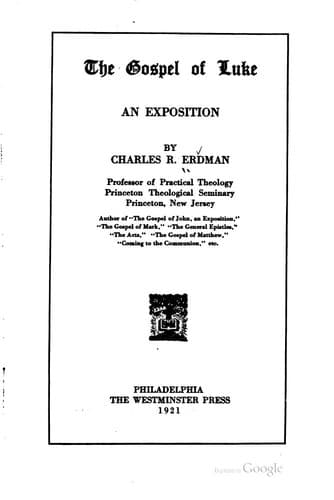
The Gospel of Luke, an expositionErdman, Charles Rosenbury
Religion
The Gospel of Luke, an exposition
Erdman, Charles Rosenbury
Bible. Luke -- Commentaries
To the question of the people John made it perfectly plain that by
repentance he meant no mere form or ceremony, nor was the word merely an
abstract theological term; the thing he demanded was plain and practical,
that each man should turn from his besetting sin and should show love to
his fellow man. Clothing and food were to be given to those in need, for
repentance meant to turn from the sin of selfishness. Publicans or
taxgatherers, who were everywhere detested because of their dishonesty and
greed, were told to demand no more tribute than was appointed and lawful.
Soldiers, or more exactly “men on military service,” possibly acting as
local police, were told to extort no money by violence and to seek for
none by false charges, and to be content with their wages. All who are to
receive Christ in any age must turn from their sins. Repentance is not a
mystical experience; it is plain and simple and practical. It consists in
turning from greed and dishonesty and unkindness and violence and
discontent, and from all that is contrary to the revealed will of God.
The coming of Christ was very definitely predicted by John. While some
imagined that the prophet himself was the Messiah, John declared that the
mission of Christ was so much greater than his own that he would be
unworthy as a slave, to loose the latchet of his shoes. While John
baptized with water, Christ would baptize with the Holy Spirit and with
fire. Water was a material element, and merely symbolized an inward
change; Jesus would bring them into fellowship with a divine Person, and
would exert upon their souls cleansing and transforming power. He would
come, however, to punish the impenitent; he would separate the wheat from
the chaff; the former he would gather into his garner, but the chaff he
would burn with unquenchable fire.
The close of the career of John is introduced by Luke at this point of his
narrative to prepare the way for his account of the ministry of Christ. It
was actually some time after Jesus had begun his work that Herod the
tetrarch arrested John and cast him into prison because he had rebuked the
profligate king for his impurity and his sin. John had been a faithful
messenger of God, but the world does not reverence its prophets; they are
usually imprisoned, beheaded, burned, or crucified.
B. The Baptism Of Jesus. Ch. 3:21, 22
21 Now it came to pass, when all the people were baptized, that,
Jesus also having been baptized, and praying, the heaven was
opened, 22 and the Holy Spirit descended in a bodily form, as a
dove, upon him, and a voice came out of heaven, Thou art my
beloved Son; in thee I am well pleased.
Public-domain text, read in full here on John Shaqi.
Reviews
Reviews
No reviews yet
Be the first to share your thoughts on this work.
Join the Discussion
Join the discussion
Sign in to leave a comment or review.
Sign InorCreate an account