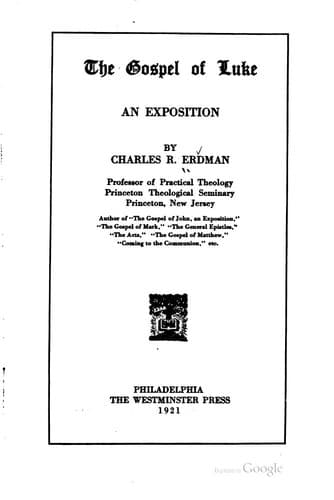
The Gospel of Luke, an expositionErdman, Charles Rosenbury
Religion
The Gospel of Luke, an exposition
Erdman, Charles Rosenbury
Bible. Luke -- Commentaries
Such a messenger appeared in the person of John the Baptist who after his
long discipline in the wilderness came with a definite message from God
and drew out great throngs to the Jordan Valley to attend his preaching
and to accept his baptism as a sign and seal of their repentance. The
nature of his ministry is declared to have been a fulfillment of the
prediction of Isaiah who described “one crying in the wilderness,” one
sent of God to prepare the way for the coming of Christ. This preparation
is pictured in terms of Oriental imagery. When a monarch was about to make
a journey, a servant was sent before him to prepare the highway. Valleys
needed to be filled, hills lowered, crooked places made straight, rough
ways made smooth. Thus, before men would be ready to receive Christ, moral
obstacles must be removed; men must repent of their sins and turn from
them. Luke closes his quotation from Isaiah with the line, “And all flesh
shall see the salvation of God,” which is in accord with the universal
character of his Gospel.
The burden of the message preached by John was that which in all ages has
awakened a response in the hearts of men: he preached sin and judgment,
repentance and pardon. The tone of his message as recorded by Luke,
however, was particularly severe; here he is said to have addressed the
multitudes as the “offspring of vipers” and to have asked them why they
were pretending to have heard a warning of wrath to come. The reason for
such severity was that, while wishing to escape the impending judgment,
the people were unwilling to forsake their sins. They regarded the baptism
of John as a magical rite which could make impenitent men safe in the hour
of judgment. John bade them show their repentance by their works and not
to trust in their descent from Abraham as securing their salvation. He
declared that judgment was upon them; the ax was already lying at the root
of the trees and every fruitless tree was about to be “hewn down, and cast
into the fire.”
Public-domain text, read in full here on John Shaqi.
Reviews
Reviews
No reviews yet
Be the first to share your thoughts on this work.
Join the Discussion
Join the discussion
Sign in to leave a comment or review.
Sign InorCreate an account