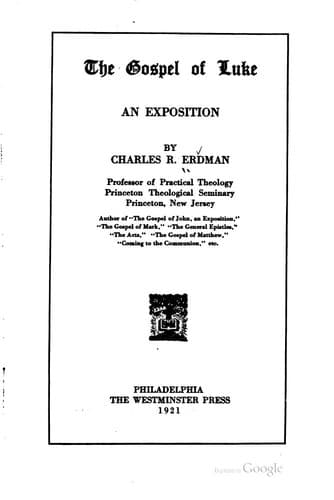
The Gospel of Luke, an expositionErdman, Charles Rosenbury
Religion
The Gospel of Luke, an exposition
Erdman, Charles Rosenbury
Bible. Luke -- Commentaries
The time of the temptation was significant. It was just after Jesus had
been filled with the Holy Spirit and had been assured anew of his divine
sonship. Under the influence of the Spirit he was brought to the place of
trial, and the temptation consisted, in large part, of the suggestion to
use for selfish ends the divine powers of which he was conscious, and to
forget his filial relation to his Father. While God never tempts us, in
the sense of enticing us to sin, it does seem to be a part of his gracious
purpose to allow us to be tested; these experiences come while we are
guided by his Spirit, and the essence of these temptations usually
consists in some inclination to please self in forgetfulness of our true
relation to God. The place of temptation was the wilderness, and there is
a sense in which the experience of moral struggle is always one of intense
loneliness. On the other hand, to live in a literal desert does not free
one from solicitation to sin. Wherever one may be, he can be certain of
the presence and sympathy of Christ; and victory is possible through faith
in him. This seems to be the supreme message of the story.
In both Matthew and Luke, three temptations are mentioned. They are
probably intended to be symbolic and inclusive; and under one or the other
of these enticements to evil can be grouped all the moral trials of
mankind. It is to be noted, however, that the order of the temptations
given by Luke differs from that of Matthew. In both accounts the first
temptation is to make bread of stone; but Luke mentions as the second
temptation that which is last in the account of Matthew, the temptation
which offered to Jesus all the kingdoms of the world. This was a fitting
climax to the testing of the King. Luke, however, mentions last the
temptation of Jesus to cast himself from the pinnacle of the Temple and
thus to test God. It is the temptation in the sphere of intellectual
desire and comes in the subtle form of presumptuous trust. It forms a true
climax in the testing of the ideal Man. The order given by Matthew is
suggested by the apostle John who mentions “the lust of the flesh and the
lust of the eyes and the vainglory of life.” The order of Luke takes us
back to the story of Eden and to the first human sin, which was due to a
love for that which was “good for food” and “a delight to the eyes” and
“to be desired to make one wise.” As in Eden also, the first temptation is
to doubt the goodness of God, the second to doubt his power, and the third
to distrust his wisdom. The victory of Jesus, however, was secured by the
triumph of his faith, and faith is still “the victory which overcomes the
world.”
Public-domain text, read in full here on John Shaqi.
Reviews
Reviews
No reviews yet
Be the first to share your thoughts on this work.
Join the Discussion
Join the discussion
Sign in to leave a comment or review.
Sign InorCreate an account