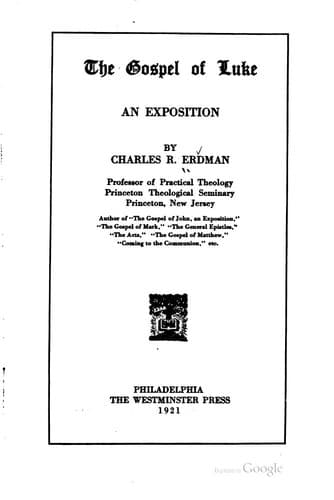
The Gospel of Luke, an expositionErdman, Charles Rosenbury
Religion
The Gospel of Luke, an exposition
Erdman, Charles Rosenbury
Bible. Luke -- Commentaries
It was a Sabbath Day. The place of worship was crowded with the relatives
and friends and townsmen of Jesus. All were eager to hear one whom they
knew so well, and who had attained so sudden a renown. Either at his
request, or providentially, Jesus was handed the book of Isaiah to lead in
the reading of the Scripture. He found the place in the prophecy where, in
terms of the joy of Jubilee, the writer is describing the gladness of
those who are to return from their long captivity in Babylon. When Jesus
had finished the lesson he sat down, thereby taking the attitude of a
public teacher. As all gazed upon him intently, he undertook to show that
the prophecy was to be fulfilled by himself, claiming thereby to be the
promised Messiah. The very phrase with which the prophecy begins, “The
Spirit of the Lord is upon me,” indicates, when applied to himself, that
he had been anointed, not with oil as a prophet or a priest or a king, but
with the Holy Spirit as the Anointed One, or the Christ of God. As such he
was “to preach good tidings to the poor,” that is, to those in spiritual
as well as in physical poverty. He was to proclaim deliverance for those
enslaved by sin and to establish those principles which will result in
political freedom for mankind. He was “to set at liberty them that are
bruised,” that is, to remove the consequences and the cruelties of
selfishness and of crime. He was to proclaim the era of universal
blessedness which will result from his perfected reign. Thus in these
words, which combine the figures of deliverance from captivity with those
of the joy of jubilee, Jesus expressed the gracious and beneficent
character of his ministry.
His auditors listened in amazement, unable to resist the charm of his
address or to deny the fascinating beauty of his words, but unable also to
admit his claim; they received his predictions with stubborn unbelief.
They expressed their incredulity and at the same time explained it by
their question, “Is not this Joseph’s son?” They were saying in effect:
“Is not this man our neighbor, the carpenter, with whom we have all been
acquainted; do we not know him and his family? Surely he cannot be the
Messiah.”
Public-domain text, read in full here on John Shaqi.
Reviews
Reviews
No reviews yet
Be the first to share your thoughts on this work.
Join the Discussion
Join the discussion
Sign in to leave a comment or review.
Sign InorCreate an account