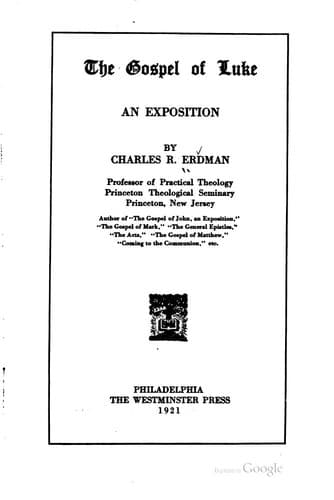
The Gospel of Luke, an expositionErdman, Charles Rosenbury
Religion
The Gospel of Luke, an exposition
Erdman, Charles Rosenbury
Bible. Luke -- Commentaries
The reply of Jesus was to the effect that their unwillingness to accept
him was due in part to the fact that he had not wrought in their presence
the miracles which marked his ministry in other places. This is what he
meant by quoting the proverb, “Physician, heal thyself,” that is,
“Establish your claim here as you have done elsewhere, if you expect to be
received as the Christ.” Jesus also quoted another proverb to explain more
fully their jealous doubts: “No prophet is acceptable in his own country.”
Those most familiar with great men usually are least able to appreciate
their greatness; “Familiarity breeds contempt,” because men are so apt to
judge one another by false standards and by that which is accidental and
external and because so frequently men do not know those whom they think
they know the best. This same stupid lack of appreciation shadows human
lives to-day, and makes us fail to realize the worth of our friends and
the value of our opportunities, until it is too late. It even has its
tragic bearing upon the present ministry of Christ; some reject him for
reasons altogether superficial and foolish, thinking that they know him
perfectly because they long have been familiar with his name, while in
reality they fail to understand the real beauty of his person and the
transforming power of his grace.
The unbelief of his auditors was turned to mad hatred as Jesus gave two
examples from Old Testament history, both of which indicated that his
townsmen, who knew him best, were less worthy of his saving ministry than
even men of heathen nations. He even compared himself with Elijah and
Elisha and indicated that as the former brought a great blessing to one
who lived in Sidon and the latter to a prince in Syria, while the people
in Israel were suffering for their unbelief, so the nations of the world
would accept the blessed salvation of Christ while those who knew him best
would suffer for their unbelief. So maddened were his hearers by this
severe rebuke that they drove him from the city and tried to take his
life, but he, with majestic calm and divine strength, “passing through the
midst of them went his way.”
It is still true that those who have enjoyed the best opportunities for
knowing Christ often reject him; but, where faith is present, broken
hearts are healed as by Elijah of old and lepers are cleansed as was
Naaman by the word of Elisha. Thus in this scene in the synagogue of
Nazareth, Jesus indicated not only the grace of his ministry but its
universal power. He came to relieve all the needs of mankind and in all
the world.
2. Jesus Performing Miracles at Capernaum. Ch. 4:31-44
Public-domain text, read in full here on John Shaqi.
Reviews
Reviews
No reviews yet
Be the first to share your thoughts on this work.
Join the Discussion
Join the discussion
Sign in to leave a comment or review.
Sign InorCreate an account