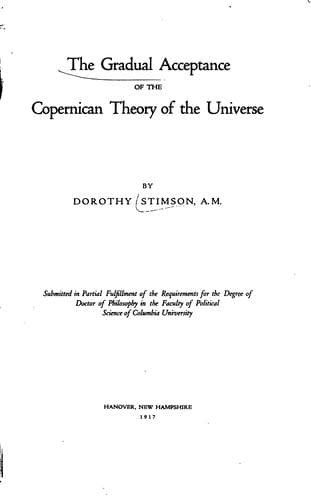
The gradual acceptance of the Copernican theory of the universeStimson, Dorothy
History
The gradual acceptance of the Copernican theory of the universe
Stimson, Dorothy
Astronomy -- History; Copernicus, Nicolaus, 1473-1543; Solar system
MYST. This fine allegory signifies that God cannot be known from
superior or antecedent causes but from behind His back, that is, from
results, for a little later He adds, "I will cover thine eyes with My
hand." Thus the hand signifies those works which He has placed before
anyone's eyes, and it indicates that He places man not in an obscure
corner but in the center of the universe so that He might better and
more easily than in heaven contemplate the universe and all His works
through the sight of which, as through spectacles, the Sun, that is,
God Himself, may be disclosed. And therefore we undertook this
disputation concerning nature and natural things, so that even if they
are but slightly explained, nevertheless we may attain from this
disquisition an imperfect knowledge of the Creator and may break forth
in His praises with all our might, that at length by degrees we may be
borne on high and be blessed by the Divine reward; for this is indeed
the supreme and final good for a man.
Here endeth the Drama of Nature which Jean Bodin wrote while
all France was aflame with civil war.
FINIS
APPENDIX D.
A TRANSLATION OF A LETTER BY THOMAS FEYENS
ON THE QUESTION: IS IT TRUE THAT THE HEAVENS ARE MOVED AND THE EARTH
IS AT REST? (FEBRUARY, 1619)
(_Thomæ Fieni Epistolica Quæstio_: An verum sit, coelum
moveri et terram quiescere? Londini, 1655.)
To the eminent and noble scholars, Tobias Matthias and George Gays:
It is proved that the heavens are moved and the earth is stationary:
First; by authority; for besides the fact that this is asserted by
Aristotle and Ptolemy whom wellnigh all Philosophers and
Mathematicians have followed by unanimous consent, except for
Copernicus, Bernardus Patricius[474] and a very few others, the Holy
Scriptures plainly attest it in at least two places which I have seen.
In Joshua,[475] are the words: Steteruntque sol et luna donec
ulcisceretur gens de inimicis suis. And a little further on: Stetit
itaque sol in medio coeli, et non festinavit occumbere spatio unius
diei, et non fuit antea et postea tam longa dies. The Scriptures
obviously refer by these words to the motion of the _primum mobile_ by
which the sun and the moon are borne along in their diurnal course and
the day is defined; and it indicates that the heavens are moved as
well as the _primum mobile_. Then Ecclesiastes, chapter 1,[476] reads:
Generatio præterit, et generatio advenit, terra autem semper stat,
oritur sol et occidit, et ad locum suum revertitur.
[Footnote 474: Feyens probably refers here to Francesco Patrizzi, who
was an enemy of the peripatetics and a great supporter of platonism.
He died in 1597 at Rome, where Clement VIII had conferred on him the
chair of philosophy.]
[Footnote 475: Joshua X: 13-14.]
[Footnote 476: Ecclesiastes I: 4.]
Secondly, it is proved by reason. All the heavens and stars were made
in man's behalf and, with other terrestrial bodies, are the servants
of man to warm, light, and vivify him.
Public-domain text, read in full here on John Shaqi.
Reviews
Reviews
No reviews yet
Be the first to share your thoughts on this work.
Elsewhere in the archive
Join the Discussion
Join the discussion
Sign in to leave a comment or review.
Sign InorCreate an account