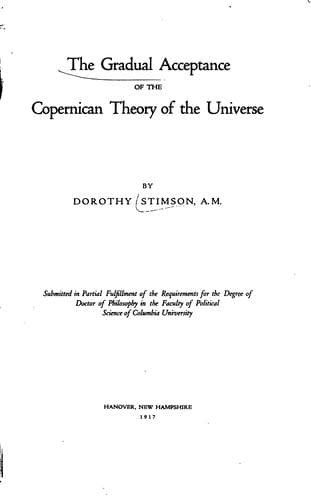
The gradual acceptance of the Copernican theory of the universeStimson, Dorothy
History
The gradual acceptance of the Copernican theory of the universe
Stimson, Dorothy
Astronomy -- History; Copernicus, Nicolaus, 1473-1543; Solar system
This they could not do unless in moving they applied themselves by
turns to different parts of the world. And it is more likely that they
would apply themselves by their own movement to man and the place in
which man lives, than that man should come to them by the movement of
his own seat or habitation. For they are the servants of man; man is
not their servant; therefore it is more probable that the heavens are
moved and the earth is at rest than that the reverse is true.
Thirdly; no probable argument can be thought out from philosophy to
prove that the earth is moved and the heavens are at rest. Nor can it
be done by mathematics. By saying that the heavens are moved and the
earth is at rest, all phenomena of the heavenly bodies can be solved.
Just as in the same way in optics all can be solved by saying either
that sight comes from the thing to the eye, or that rays go from the
eye to the thing seen; so is it in astronomy. Therefore one ought
rather to abide in the ancient and general opinion than in one
received recently without justification.
Fourthly; the earth is the center of the universe; all the heavenly
bodies are observed to be moved around it; therefore it itself ought
to be motionless, for anything that moves, it seems, should move
around or above something that is motionless.
Fifthly; if the earth is moved in a circle, either it moves that way
naturally or by force, either by its own nature or by the nature of
another. It is not by its own nature, for straight motion from above
downward is natural to it; therefore circular motion could not be
natural to it. Further, the earth is a simple body; and a simple body
can not have two natural motions of distinct kinds or classes. Nor is
it moved by another body; for by what is it moved? One has to say it
is moved either by the sun or by some other celestial body; and this
cannot be said, since either the sun or that body is said to be at
rest or in motion. If it is said to be at rest, then it cannot impart
movement to another. If it is said to be in motion, then it can not
move the earth, because it ought to move either by a motion similar to
its own or the opposite of it. It is not similar, since thus it would
be observed to move neutrally as when two boats moving in the same
direction, appear not to move but to be at rest. It is not the
opposite motion, since nothing could give motion contrary to its own.
And because Galileo seems to say, in so far as I have learned from
your lordships, that the earth was moved by the sun; I prove anyway
that this is not true since the movement of the sun and of the earth
ought to be from contrary and distinct poles. The sun, however, can
not be the cause of the other's movement because it is moved above
different poles. Lastly, the earth follows the motion of no other
celestial body; since if it is moved, it moves in 24 hours, and all
the other celestial bodies require the space of many days, months and
years. Ergo.
Public-domain text, read in full here on John Shaqi.
Reviews
Reviews
No reviews yet
Be the first to share your thoughts on this work.
Elsewhere in the archive
Join the Discussion
Join the discussion
Sign in to leave a comment or review.
Sign InorCreate an account