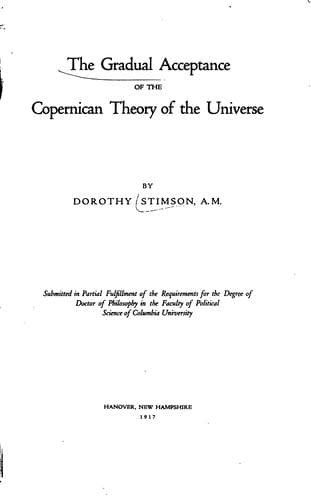
The gradual acceptance of the Copernican theory of the universeStimson, Dorothy
History
The gradual acceptance of the Copernican theory of the universe
Stimson, Dorothy
Astronomy -- History; Copernicus, Nicolaus, 1473-1543; Solar system
Finally, if the earth is moved by another, its motion
would be violent; but this is absurd, for no violence can be regular
and perpetual.
Sixthly; even so it is declared that the earth is moved. Nevertheless,
it must be admitted to this that either the planets themselves or
their spheres are moved, for in no other way can the diversities of
aspects among themselves be solved; nor can a reason be given why the
sun does not leave the Ecliptic and the moon does; and how a planet
can be stationary or retrograde, high or low,--and many other
phenomena. For this reason those who said the earth moved, as
Bernardus Patricius and the others said, claimed that the _primum
mobile_, forsooth, was stationary and that the earth was moved in its
place; yet they could not in the least deny that the planets
themselves were moved, but admitted it. That is the reason why both
ancient and modern mathematicians, aside from the motion of the
_primum mobile_, were forced to admit and consider the peculiar
movements of the planets themselves. If therefore it must be
acknowledged, and it is certain, that the stars and the celestial
bodies are moved; then it is more probable that all movement perceived
in the universe belongs rather to the heavenly bodies than to the
earth. For if movement were ascribed to all the rest, why for that
same reason is not diurnal rotation ascribed rather to the _primum
mobile_ than to the earth, particularly when our senses seem to decide
thus? Although one may well be mistaken, sometimes, concerning other
similar movements; yet it is not probable that all ages could be at
fault, or should be, about the movements of its most important
objects, of course the celestial luminaries.
Seventhly; it is proved by experience. For if the earth is moved, then
an arrow shot straight up on high could never fall back to the place
whence it was shot, but should fall somewhere many miles away. But
this is not so. Ergo.
This can be answered and is so customarily in this way: this does not
follow because the air is swept along with the earth, and so, since
the air which carries the arrow is turning in the same way with the
earth, the arrow also is borne along equally with it, and thus returns
to the same spot. This in truth is a pure evasion and a worthless
answer for many reasons.
It is falsely observed that the air is moved and by the same motion as
the earth. For what should move the earth? Truly, if the air is moved
by the same motion as the earth, either it ought to be moved by the
earth itself, or by that other which moves the earth, or by itself. It
is not moved by itself; since it has another motion, the straight one
of course natural to itself, and also since it has a nature, an
essence and qualities all different from the nature and the essence of
the earth; therefore it could not by its own nature have the same
motion as that other, but of necessity ought to have a different one.
Public-domain text, read in full here on John Shaqi.
Reviews
Reviews
No reviews yet
Be the first to share your thoughts on this work.
Elsewhere in the archive
Join the Discussion
Join the discussion
Sign in to leave a comment or review.
Sign InorCreate an account