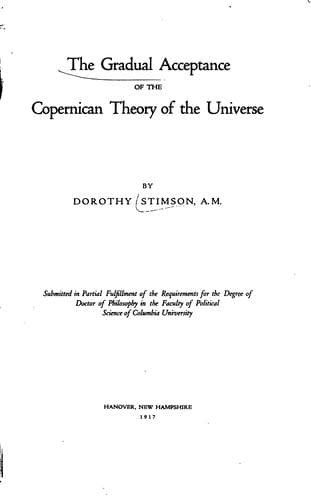
The gradual acceptance of the Copernican theory of the universeStimson, Dorothy
History
The gradual acceptance of the Copernican theory of the universe
Stimson, Dorothy
Astronomy -- History; Copernicus, Nicolaus, 1473-1543; Solar system
[Footnote 56: Delambre: _Moyen Age_, 262-272.]
[Footnote 57: Delambre: _Moyen Age_, 272.]
Regiomontanus[58] (1436-1476) after Pürbach's death, continued his
work, and his astronomical tables (pub. 1475) were in general use
throughout Europe till superseded by the vastly more accurate
Copernican Tables a century later. It has been said[59] that his fame
inspired Copernicus (born three years before the other's death in
1476) to become as great an astronomer. M. Delambre hails him as the
wisest astronomer Europe had yet produced[60] and certainly his renown
was approached only by that of the great Cardinal.
[Footnote 58: It has been claimed that Regiomontanus knew of the
earth's motion around the sun a hundred years before Copernicus; but a
German writer has definitely disproved this claim by tracing it to its
source in Schöner's _Opusculum Geographicum_ (1553) which states only
that he believed in the earth's axial rotation. Ziegler: 62.]
[Footnote 59: Ibid: 62.]
[Footnote 60: Delambre: _Op. cit._: 365.]
Both Janssen,[61] the Catholic historian, and Father Hagen[62] of the
Vatican Observatory, together with many other Catholic writers, claim
that a hundred years before Copernicus, Cardinal Nicolas Cusanus[63]
(c. 1400-1464) had the courage and independence to uphold the theory
of the earth's motion and its rotation on its axis. As Father Hagen
remarked: "Had Copernicus been aware of these assertions he would
probably have been encouraged by them to publish his own monumental
work." But the Cardinal stated these views of the earth's motions in a
mystical, hypothetical way which seems to justify the marginal heading
"Paradox" (in the edition of 1565).[64] And unfortunately for these
writers, the Jesuit father, Riccioli, the official spokesman of that
order in the 17th century after Galileo's condemnation, speaking of
this paradox, called attention, also, to a passage in one of the
Cardinal's sermons as indicating that the latter had perhaps
"forgotten himself" in the _De Docta Ignorantia_, or that this paradox
"was repugnant to him, or that he had thought better of it."[65] The
passage he referred to is as follows: "Prayer is more powerful than
all created things. Although angels, or some kind of beings, move the
spheres, the Sun and the stars; prayer is more powerful than they are,
since it impedes motion, as when the prayer of Joshua made the Sun
stand still."[66] This may explain why Copernicus apparently
disregarded the Cardinal's paradox, for he made no reference to it in
his book; and the statement itself, to judge by the absence of
contemporary comment, aroused no interest at the time. But of late
years, the Cardinal's position as stated in the _De Docta Ignorantia_
has been repeatedly cited as an instance of the Church's friendly
attitude toward scientific thought,[67] to show that Galileo's
condemnation was due chiefly to his "contumacy and disobedience."
[Footnote 61: Janssen: _Hist. of Ger._, I, 5.]
Public-domain text, read in full here on John Shaqi.
Reviews
Reviews
No reviews yet
Be the first to share your thoughts on this work.
Join the Discussion
Join the discussion
Sign in to leave a comment or review.
Sign InorCreate an account