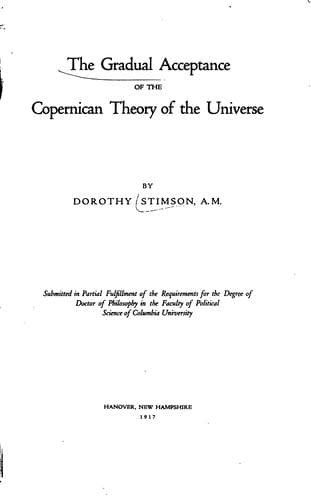
The gradual acceptance of the Copernican theory of the universeStimson, Dorothy
History
The gradual acceptance of the Copernican theory of the universe
Stimson, Dorothy
Astronomy -- History; Copernicus, Nicolaus, 1473-1543; Solar system
During these centuries, one notable scholar at least stood forth in
open hostility to the slavish devotion to Aristotle's writings and
with hearty appreciation for the greater scientific accuracy of
"infidel philosophers among the Arabians, Hebrews and Greeks."[51] In
his _Opus Tertium_ (1267), Roger Bacon also pointed out how inaccurate
were the astronomical tables used by the Church, for in 1267,
according to these tables "Christians will fast the whole week
following the true Easter, and will eat flesh instead of fasting at
Quadragesima for a week--which is absurd," and thus Christians are
made foolish in the eyes of the heathen.[52] Even the rustic, he
added, can observe the phases of the moon occurring a week ahead of
the date set by the calendar.[53] Bacon's protests were unheeded,
however, and the Church continued using the old tables which grew
increasingly inaccurate with each year. Pope Sixtus IV sought to
reform the calendar two centuries later with the aid of Regiomontanus,
then the greatest astronomer in Europe (1475);[54] the Lateran Council
appealed to Copernicus for help (1514), but little could be done, as
Copernicus replied, till the sun's and the moon's positions had been
observed far more precisely;[55] and the modern scientific calendar
was not adopted until 1582 under Pope Gregory XIII.
[Footnote 51: Roger Bacon: _Opus Tertium_, 295, 30-31.]
[Footnote 52: Ibid: 289.]
[Footnote 53: Ibid: 282.]
[Footnote 54: Delambre: _Moyen Age_, 365.]
[Footnote 55: Prowe: II, 67-70.]
What was the state of astronomy in the century of Copernicus's birth?
Regiomontanus--to use Johann Müller's Latin name--his teacher Pürbach,
and the great cardinal Nicolas of Cues were the leading astronomers of
this fifteenth century. Pürbach[56] (1432-1462) died before he had
fulfilled the promise of his youth, leaving his _Epitome of Ptolemy's
Almagest_ to be completed by his greater pupil. In his _Theorica
Planetarum_ (1460) Pürbach sought to explain the motions of the
planets by placing each planet between the walls of two curved
surfaces with just sufficient space in which the planet could move. As
M. Delambre remarked:[57] "These walls might aid the understanding,
but one must suppose them transparent; and even if they guided the
planet as was their purpose, they hindered the movement of the comets.
Therefore they had to be abandoned, and in our own modern physics they
are absolutely superfluous; they have even been rather harmful, since
they interfered with the slight irregularities caused by the force of
attraction in planetary movements which observations have disclosed."
This scheme gives some indication of the elaborate devices scholars
evolved in order to cope with the increasing number of seeming
irregularities observed in "the heavens," and perhaps it makes clearer
why Copernicus was so dissatisfied with the astronomical hypothesis of
his day, and longed for some simpler, more harmonious explanation.
Public-domain text, read in full here on John Shaqi.
Reviews
Reviews
No reviews yet
Be the first to share your thoughts on this work.
Join the Discussion
Join the discussion
Sign in to leave a comment or review.
Sign InorCreate an account