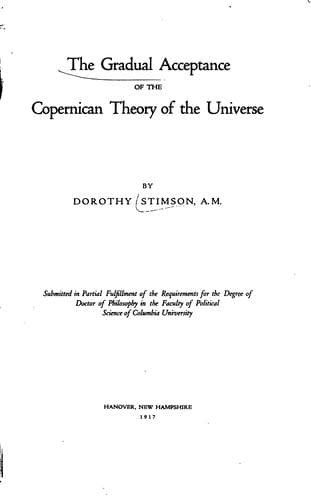
The gradual acceptance of the Copernican theory of the universeStimson, Dorothy
History
The gradual acceptance of the Copernican theory of the universe
Stimson, Dorothy
Astronomy -- History; Copernicus, Nicolaus, 1473-1543; Solar system
In the original MS. occurs a reference (struck out) to Aristarchus of
Samos as holding the theory of the earth's motion. (Prowe: II, 507,
note.) The finding of this passage proves that Copernicus had at least
heard of Aristarchus, but his apparent indifference is the more
strange since an account of his teaching occurs in the same book of
Plutarch from which Copernicus learned about Philolaus. But the chief
source of our knowledge about Aristarchus is through Archimedes, and
the editio princeps of his works did not appear till 1544, a year
after the death of Copernicus. C.R. Eastman in _Pop. Sci._ 68:325.]
[Footnote 112: Delambre: _Astr. Mod._ pp. xi-xii.]
[Footnote 113: As the earth moves, the position in the heavens of a
fixed star seen from the earth should differ slightly from its
position observed six months later when the earth is on the opposite
side of its orbit. The distance to the fixed stars is so vast,
however, that this final proof of the earth's motion was not attained
till 1838 when Bessel (1784-1846) observed stellar parallax from
Königsberg. Berry: 123-24.]
[Footnote 114: _Commentariolus_ in Prowe: III, 202.]
[Footnote 115: Holden in _Pop. Sci._, 117.]
[Footnote 116: Delambre: _Astr. Mod._, p. xi.]
[Footnote 117: Snyder: 165.]
Copernicus was extremely reluctant to publish his book because of the
misunderstandings and malicious attacks it would unquestionably
arouse.[118] Possibly, too, he was thinking of the hostility already
existing between himself and his Bishop, Dantiscus,[119] whom he did
not wish to antagonize further. But his devoted pupil and friend,
Rheticus, aided by Tiedeman Giese, Bishop of Culm and a lifelong
friend, at length (1542) persuaded him.[120] So he entrusted the
matter to Giese who passed it on to Rheticus, then connected with the
University at Wittenberg as professor of mathematics.[121] Rheticus,
securing leave of absence from Melancthon his superior, went to
Nürnberg to supervise the printing.[122] This was done by Petrejus.
Upon his return to Wittenberg, Rheticus left in charge Johann Schöner,
a famous mathematician and astronomer, and Andreas Osiander, a
Lutheran preacher interested in astronomy. The printed book[123] was
placed in Copernicus's hands at Frauenburg on May 24th, 1543, as he
lay dying of paralysis.[124]
[Footnote 118: Copernicus: Dedication, 3.]
[Footnote 119: Prowe: II, 362-7.]
[Footnote 120: Ibid: II, 406.]
[Footnote 121: Ibid: II, 501.]
[Footnote 122: Ibid: II, 517-20.]
[Footnote 123: Four other editions have since appeared; at Basel,
1566, Amsterdam 1617, Warsaw 1847, and Thorn 1873. For further
details, see Prowe: II, 543-7, and Thorn edition pp. xii-xx. The
edition cited in this study is the Thorn one of 1873.]
[Footnote 124: Prowe: II, 553-4.]
Public-domain text, read in full here on John Shaqi.
Reviews
Reviews
No reviews yet
Be the first to share your thoughts on this work.
Join the Discussion
Join the discussion
Sign in to leave a comment or review.
Sign InorCreate an account