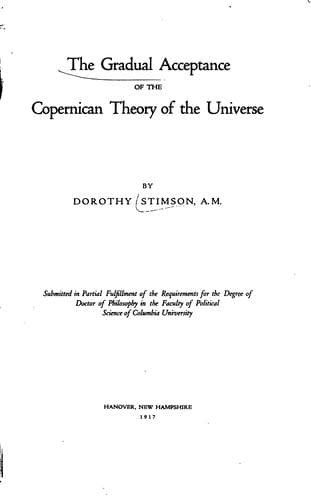
The gradual acceptance of the Copernican theory of the universeStimson, Dorothy
History
The gradual acceptance of the Copernican theory of the universe
Stimson, Dorothy
Astronomy -- History; Copernicus, Nicolaus, 1473-1543; Solar system
Copernicus passed away that day in ignorance that his life's work
appeared before the world not as a truth but as an hypothesis; for
there had been inserted an anonymous preface "ad lectorem de
hypothesibus huius opera" stating this was but another hypothesis for
the greater convenience of astronomers.[125] "Neque enim necesse est
eas hypotheses esse veras, imo ne verisimiles quidem, sed sufficit hoc
unum, si calculum observationibus congruentem exhibeant."[126] For
years Copernicus was thought to have written this preface to disarm
criticism. Kepler sixty years later (1601) called attention to this
error,[127] and quoted Osiander's letters to Copernicus and to
Rheticus of May, 1541, suggesting that the system be called an
hypothesis to avert attacks by theologians and Aristotelians. He
claimed that Osiander had written the preface; but Kepler's article
never was finished and remained unpublished till 1858.[128] Giese and
Rheticus of course knew that the preface falsified Copernicus's work,
and Giese, highly indignant at the "impiety" of the printer (who he
thought had written it to save himself from blame) wrote Rheticus
urging him to write another "præfatiunculus" purging the book of this
falsehood.[129] This letter is dated July 26, 1543, and the book had
appeared in April. Apparently nothing was done and the preface was
accepted without further challenge.
[Footnote 125: Copernicus: _De Revolutionibus_, I. "To the reader on
the hypotheses of this book."]
[Footnote 126: "For it is not necessary that these hypotheses be true,
nor even probable, but this alone is sufficient, if they show
reasoning fitting the observations."]
[Footnote 127: Kepler: _Apologia Tychonis contra Ursum_ in _Op. Om._:
I, 244-246.]
[Footnote 128: Prowe: II, 251, note.]
[Footnote 129: Ibid: II, 537-9.]
It remains to ask whether people other than Copernicus's intimates had
known of his theory before 1543. Peucer, Melancthon's nephew, declared
Copernicus was famous by 1525,[130] and the invitation from the
Lateran Council committee indicates his renown as early as 1514. In
Vienna in 1873[131] there was found a _Commentariolus_, or summary of
his great work,[132] written by Copernicus for the scholars friendly
to him. It was probably written soon after 1530, and gives a full
statement of his views following a series of seven axioms or theses
summing up the new theory. This little book probably occasioned the
order from Pope Clement VII in 1533 to Widmanstadt to report to him on
the new scheme.[133] This Widmanstadt did in the papal gardens before
the Pope with several of the cardinals and bishops, and was presented
with a book as his reward.
[Footnote 130: Ibid: II, 273.]
[Footnote 131: Ibid: II, 286-7.]
[Footnote 132: A second copy was found at Upsala shortly afterwards,
though for centuries its existence was unknown save for two slight
references to such a book, one by Gemma Frisius, the other by Tycho
Brahe. Prowe: II, 284.]
[Footnote 133: Ibid: II, 273-4.]
Public-domain text, read in full here on John Shaqi.
Reviews
Reviews
No reviews yet
Be the first to share your thoughts on this work.
Join the Discussion
Join the discussion
Sign in to leave a comment or review.
Sign InorCreate an account