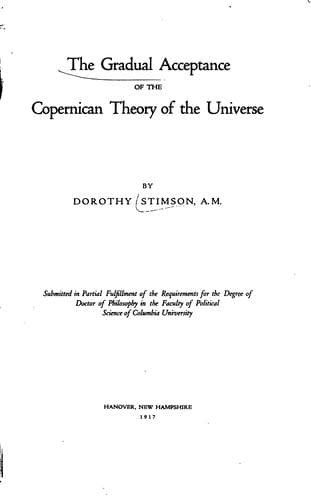
The gradual acceptance of the Copernican theory of the universe — John Shaqi
The gradual acceptance of the Copernican theory of the universeStimson, Dorothy
History
The gradual acceptance of the Copernican theory of the universe
Stimson, Dorothy
Astronomy -- History; Copernicus, Nicolaus, 1473-1543; Solar system
This "Phoenix among Astronomers"--as Kepler calls him,[150]--was the
father of modern practical astronomy.[151] He also propounded a third
system of the universe, a compromise between the Ptolemaic and the
Copernican. In this the Tychonic system,[152] the earth is motionless
and is the center of the orbits of the sun, the moon, and the sphere
of the fixed stars, while the sun is the center of the orbits of the
five planets.[153] Mercury and Venus move in orbits with radii shorter
than the sun's radius, and the other three planets include the earth
within their circuits. This system was in harmony with the Bible and
accounted as satisfactorily by geometry as either of the other two
systems for the observed phenomena.[154] To Tycho Brahe, the Ptolemaic
system was too complex,[155] and the Copernican absurd, the latter
because to account for the absence of stellar parallax it left vacant
and purposeless a vast space between Saturn and the sphere of the
fixed stars,[156] and because Tycho's observations did not show any
trace of the stellar parallax that must exist if the earth moves.[157]
[Footnote 150: Kepler: _Tabulæ Rudolphinæ_. Title page.]
[Footnote 151: Dreyer: 317-363.]
[Footnote 152: As stated in his Book on the Comet of 1577 (pub.
1588).]
[Footnote 153: Dreyer: 168-9.]
[Footnote 154: Schiaparelli in Snyder: 165.]
[Footnote 155: Brahe: _Op. Om._, pt. I, p. 337.]
[Footnote 156: Ibid: 409-410.]
[Footnote 157: The Tychonic system has supporters to this day. See
chap. viii.]
Though Tycho thus rejected the Copernican theory, his own proved to be
the stepping stone toward the one he rejected,[158] for by it and by
his study of comets he completely destroyed the ideas of solid
crystalline spheres to the discredit of the scholastics; and his
promulgation of a third theory of the universe helped to diminish
men's confidence in authority and to stimulate independent thinking.
[Footnote 158: Dreyer: 181.]
Copernicus worked out his system by mathematics with but slight aid
from his own observations. It was a theory not yet proven true. Tycho
Brahe, though denying its validity, contributed in his mass of
painstaking, accurate observations the raw material of facts to be
worked up by Kepler into the great laws of the planets attesting the
fundamental truth of the Copernican hypothesis.
Public-domain text, read in full here on John Shaqi.
Reviews
Reviews
No reviews yet
Be the first to share your thoughts on this work.
Join the Discussion
Join the discussion
Sign in to leave a comment or review.
Sign InorCreate an account