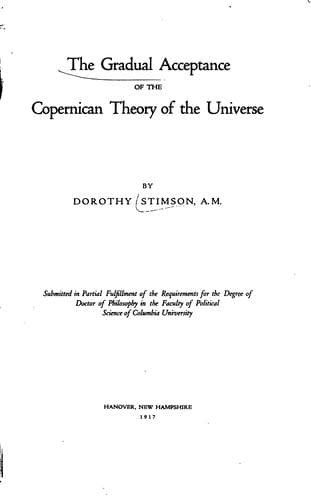
The gradual acceptance of the Copernican theory of the universeStimson, Dorothy
History
The gradual acceptance of the Copernican theory of the universe
Stimson, Dorothy
Astronomy -- History; Copernicus, Nicolaus, 1473-1543; Solar system
His life[143] was a somewhat romantic one. Born of noble family on
December 14th, 1546, at Knudstrup in Denmark, Tyge Brahe, the second
of ten children,[144] was early practically adopted by his father's
brother. His family wished him to become a statesman and sent him in
1559 to the university at Copenhagen to prepare for that career. A
partial eclipse of the sun on August 21st, 1560 as foretold by the
astronomers thrilled the lad and determined him to study a science
that could foretell the future and so affect men's lives.[145] When he
was sent to Leipsic with a tutor in 1562 to study law, he devoted his
time and money to the study of mathematics and astronomy. Two years
later when eighteen years of age, he resolved to perform anew the task
of Hipparchos and Ptolemy and make a catalogue of the stars more
accurate than theirs. His family hotly opposed these plans; and for
six years he wandered through the German states, now at Wittenberg,
now at Rostock (where he fought the duel in which he lost part of his
nose and had to have it replaced by one of gold and silver)[146] or at
Augsburg--everywhere working on his chosen subjects. But upon his
return to Denmark (1570) he spent two years on chemistry and medicine,
till the startling appearance of the New Star in the constellation of
Cassiopæa (November, 1572) recalled him to what became his life
work.[147]
[Footnote 143: Dreyer: 11-84.]
[Footnote 144: Gassendi: 2.]
[Footnote 145: Dreyer: 13.]
[Footnote 146: Gassendi: 9-10.]
[Footnote 147: Dreyer: 38-44.]
Through the interest and favor of King Frederick II, he was given the
island of Hveen near Elsinore, with money to build an observatory and
the pledge of an annual income from the state treasury for his
support.[148] There at Uraniborg from 1576 to 1597 he and his pupils
made the great catalogue of the stars, and studied comets and the
moon. When he was forced to leave Hveen by the hostility and the
economical tendencies of the young king,[149] after two years of
wandering he accepted the invitation of the Emperor Rudolphus and
established himself at Prague in Bohemia. Among his assistants at
Prague was young Johann Kepler who till Tycho's death (on October 24,
1601) was his chief helper for twenty months, and who afterwards
completed his observations, publishing the results in the Rudolphine
Tables of 1627.
[Footnote 148: Ibid: 84.]
[Footnote 149: Ibid: 234-5.]
Public-domain text, read in full here on John Shaqi.
Reviews
Reviews
No reviews yet
Be the first to share your thoughts on this work.
Join the Discussion
Join the discussion
Sign in to leave a comment or review.
Sign InorCreate an account