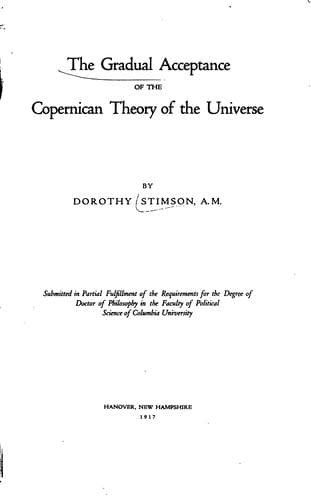
The gradual acceptance of the Copernican theory of the universe — John Shaqi
The gradual acceptance of the Copernican theory of the universeStimson, Dorothy
History
The gradual acceptance of the Copernican theory of the universe
Stimson, Dorothy
Astronomy -- History; Copernicus, Nicolaus, 1473-1543; Solar system
With the researches of Tycho's lifetime placed at his disposal, Kepler
worked out two of his three great planetary laws from Tycho's
observations of the planet Mars. Yet, as M. Bertrand remarks,[167] it
was well for Kepler that his material was not too accurate or its
variations (due to the then unmeasured force of attraction) might have
hindered him from proving his laws; and luckily for him the earth's
orbit is so nearly circular that in calculating the orbit of Mars to
prove its elliptical form, he could base his work on the earth's orbit
as a circle without vitiating his results for Mars.[168] That a
planet's orbit is an ellipse and not the perfect circle was of course
a triumph for the new science over the scholastics and Aristotelians.
But they had yet to learn what held the planets in their courses.
[Footnote 167: Bertrand: p. 870-1.]
[Footnote 168: The two laws first appeared in 1609 in his _Physica
Coelestis tradita commentarius de motu stellæ martis_. (Frisch:
VIII, 964.) The third he enunciated in his _Harmonia Mundi_, 1619.
(Ibid: VIII, 1013-1017.)]
From Kepler's student days under Mæstlin when as the subject of his
disputation he upheld the Copernican theory, to his death in 1630, he
was a staunch supporter of the new teaching.[169] In his _Epitome
Astronomiæ Copernicanæ_ (1616) he answered objections to it at
length.[170] He took infinite pains to convert his friends to the new
system. It was in vain that Tycho on his deathbed had urged Kepler to
carry on their work not on the Copernican but on the Tychonic
scheme.[171]
[Footnote 169: "Cor et animam meam": Kepler's expression in regard to
the Copernician theory. Ibid: VIII, 957.]
[Footnote 170: Ibid: VIII, 838.]
[Footnote 171: Ibid: VIII, 742.]
Kepler had reasoned out according to physics the laws by which the
planets moved.[172] In Italy at this same time Galileo with his optic
tube (invented 1609) was demonstrating that Venus had phases even as
Copernicus had declared, that Jupiter had satellites, and that the
moon was scarred and roughened--ocular proof that the old system with
its heavenly perfection in number (7 planets) and in appearance must
be cast aside. Within a year after Galileo's death Newton was
born[173] (January 4, 1643). His demonstration of the universal
application of the law of gravitation (1687) was perhaps the climax in
the development of the Copernican system. Complete and final proof
was adding in the succeeding years by Roemer's (1644-1710) discovery
of the velocity of light, by Bradley's (1693-1762) study of its
aberration,[174] by Bessel's discovery of stellar parallax in
1838,[175] and by Foucault's experimental demonstration of the earth's
axial motion with a pendulum in 1851.[176]
[Footnote 172: Kepler: _Op. Om._, I, 106: _Præfatio ad Lectorem_.]
[Footnote 173: Berry: 210.]
[Footnote 174: Berry: 265.]
[Footnote 175: Ibid: 359.]
[Footnote 176: Jacoby: 89.]
PART TWO
THE RECEPTION OF THE COPERNICAN THEORY.
CHAPTER I.
Public-domain text, read in full here on John Shaqi.
Reviews
Reviews
No reviews yet
Be the first to share your thoughts on this work.
Join the Discussion
Join the discussion
Sign in to leave a comment or review.
Sign InorCreate an account