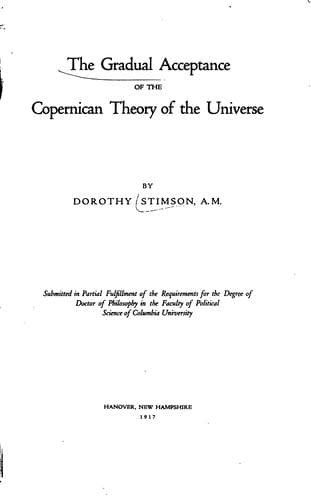
The gradual acceptance of the Copernican theory of the universeStimson, Dorothy
History
The gradual acceptance of the Copernican theory of the universe
Stimson, Dorothy
Astronomy -- History; Copernicus, Nicolaus, 1473-1543; Solar system
OPINIONS AND ARGUMENTS IN THE SIXTEENTH CENTURY.
During the lifetime of Copernicus, Roman Catholic churchmen had been
interested in his work: Cardinal Schönberg wrote for full information,
Widmanstadt reported on it to Pope Clement VII and Copernicus had
dedicated his book to Pope Paul III.[177] But after his death, the
Church authorities apparently paid little heed to his theory until
some fifty years later when Giordano Bruno forced it upon their
attention in his philosophical teachings. Osiander's preface had
probably blinded their eyes to its implications.
[Footnote 177: See before, p. 30.]
The Protestant leaders were not quite so urbane in their attitude.
While Copernicus was still alive, Luther is reported[178] to have
referred to this "new astrologer" who sought to prove that the earth
and not the firmament swung around, saying: "The fool will overturn
the whole science of astronomy. But as the Holy Scriptures state,
Joshua bade the sun stand still and not the earth." Melancthon was
more interested in this new idea, perhaps because of the influence of
Rheticus, his colleague in the University of Wittenberg and
Copernicus's great friend and supporter; but he too preferred not to
dissent from the accepted opinion of the ages.[179] Informally in a
letter to a friend he implies the absurdity of the new teaching,[180]
and in his _Initia Doctrinæ Physicæ_ he goes to some pains to disprove
the new assumption not merely by mathematics but by the Bible, though
with a kind of apology to other physicists for quoting the Divine
Witness.[181] He refers to the phrase in Psalm XIX likening the sun in
its course "to a strong man about to run a race," proving that the sun
moves. Another Psalm states that the earth was founded not to be moved
for eternity, and a similar phrase occurs in the first chapter of
Ecclesiastes. Then there was the miracle when Joshua bade the sun
stand still. While this is a sufficient witness to the truths there
are other proofs: First, in the turning of a circumference, the center
remains motionless. Next, changes in the length of the day and of the
seasons would ensue, were the position of the earth in the universe
not central, and it would not be equidistant from the two poles. (He
has previously disposed of infinity by stating that the heavens
revolve around the pole, which could not happen if a line drawn from
the center of the universe were infinitely projected).[182]
Furthermore, the earth must be at the center for its shadow to fall
upon the moon in an eclipse. He refers next to the Aristotelian
statement that to a simple body belongs one motion: the earth is a
simple body; therefore it can have but one motion. What is true of the
parts applies to the whole; all the parts of the earth are borne
toward the earth and there rest; therefore the whole earth is at rest.
Quiet is essential to growth. Lastly, if the earth moved as fast as it
must if it moves at all, everything would fly to pieces.[183]
Public-domain text, read in full here on John Shaqi.
Reviews
Reviews
No reviews yet
Be the first to share your thoughts on this work.
Join the Discussion
Join the discussion
Sign in to leave a comment or review.
Sign InorCreate an account