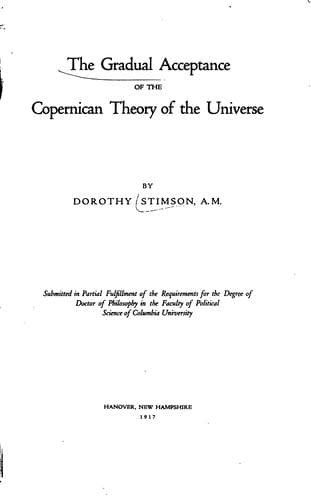
The gradual acceptance of the Copernican theory of the universeStimson, Dorothy
History
The gradual acceptance of the Copernican theory of the universe
Stimson, Dorothy
Astronomy -- History; Copernicus, Nicolaus, 1473-1543; Solar system
How widespread among the people generally did this theory become in
the years immediately following the publication of the _De
Revolutionibus_? M. Flammarion, in his _Vie de Copernic_ (1872),
refers[187] to the famous clock in the Strasburg Cathedral as having
been constructed by the University of Strasburg in protest against the
action taken by the Holy Office against Galileo, (though the clock
was constructed in 1571 and Galileo was not condemned until 1633).
This astronomical clock constructed only thirty years after the death
of Copernicus, he claims represented the Copernican system of the
universe with the planets revolving around the sun, and explained
clearly in the sight of the people what was the thought of the makers.
Lest no one should miscomprehend, he adds, the portrait of Copernicus
was placed there with this inscription: Nicolai Copernici vera
effigies, ex ipsius autographo depicta.
[Footnote 187: P. 78-79: "Ce planétaire ... represente le système du
monde tel qu'il a été expliqué par Copernic."]
This would be important evidence of the spread of the theory were it
true. But M. Flammarion must have failed to see a brief description of
the Strasburg Clock written in 1856 by Charles Schwilgué, son of the
man who renovated its mechanism in 1838-1842. He describes the clock
as it was before his father made it over and as it is today.
Originally constructed in 1352, it was replaced in 1571 by an
astrolabe based on the Ptolemaic system; six hands with the zodiacal
signs of the planets gave their daily movements and, together with a
seventh representing the sun, revolved around a map of the world.[188]
When M. Schwilgué repaired the clock in 1838, he changed it to
harmonize with the Copernican system.[189]
[Footnote 188: Schwilgué: p. 15.]
[Footnote 189: Ibid: p. 48.]
But within eighteen years after the publication of the _De
Revolutionibus_, proof of its influence is to be found in such widely
separated places as London and the great Spanish University of
Salamanca. In 1551, Robert Recorde, court physician to Edward and to
Mary and teacher of mathematics, published in London his _Castle of
Knowledge_, an introduction to astronomy and the first book printed in
England describing the Copernican system.[190] He evidently did not
consider the times quite ripe for a full avowal of his own allegiance
to the new doctrine, but the remarks of the _Maister_ and the
_Scholler_ are worth repeating:[191]
Public-domain text, read in full here on John Shaqi.
Reviews
Reviews
No reviews yet
Be the first to share your thoughts on this work.
Join the Discussion
Join the discussion
Sign in to leave a comment or review.
Sign InorCreate an account