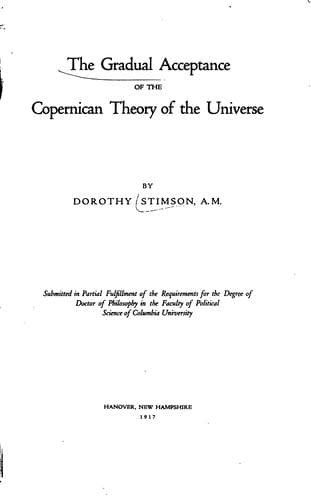
The gradual acceptance of the Copernican theory of the universeStimson, Dorothy
History
The gradual acceptance of the Copernican theory of the universe
Stimson, Dorothy
Astronomy -- History; Copernicus, Nicolaus, 1473-1543; Solar system
"MAISTER: ... howbeit Copernicus a man of great learning, of
much experience, and of wonderfull diligence in observation,
hath renewed the opinion of Aristarchus Samius, affirming
that the earth, not onely moveth circularly about his owne
centre, but also may be, yea and is, continually out of the
precise centre of the world eight and thirty hundred
thousand miles: but because the understanding of that
controversie depends of profounder knowledge than in this
Introduction may be uttered conveniently, I wil let it passe
til some other time.
"SCHOLLER: Nay sit, in good faith, I desire not to heare
such vaine fantasies, so farre against the common reason,
and repugnant to the content of all the learned multitude of
Writers, and therefore let it passe for ever and a day
longer.
"MAISTER: You are too yong to be a good judge in so great a
matter: it passeth farre your learning, and their's also,
that are much better learned than you, to improuve his
supposition by good arguments, and therefore you were best
condemne nothing that you do not well understand: but an
other time, as I saide, I will so declare his supposition,
that you shall not onely wonder to heare it, but also
peradventure be as earnest then to credite it, as you are
now to condemne it: in the meane season let us proceed
forward in our former order...."
[Footnote 190: _Dict. of Nat. Biog._: "Recorde."]
[Footnote 191: Quoted (p. 135), from the edition of 1596 in the
library of Mr. George A. Plimpton. See also Recorde's _Whetstone of
Witte_ (1557) as cited by Berry, 127.]
This little book, reprinted in 1556 and in 1596, and one of the most
popular of the mathematical writings in England during that century,
must have interested the English in the new doctrine even before
Bruno's emphatic presentation of it to them in the eighties.
Yet the English did not welcome it cordially. One of the most popular
books of this period was Sylvester's translation (1591) of DuBartas's
_The Divine Weeks_ which appeared in France in 1578, a book loved
especially by Milton.[192] DuBartas writes:[193]
"Those clerks that think--think how absurd a jest!
That neither heavens nor stars do turn at all,
Nor dance around this great, round earthly ball,
But the earth itself, this massy globe of our's,
Turns round about once every twice twelve hours!
And we resemble land-bred novices
New brought aboard to venture on the seas;
Who at first launching from the shore suppose
The ship stands still and that the firm earth goes."
[Footnote 192: DuBartas: _The Divine Weeks_ (Sylvester's trans. edited
by Haight): Preface, pp. xx-xxiii and note.]
[Footnote 193: _Op. cit._: 72.]
Public-domain text, read in full here on John Shaqi.
Reviews
Reviews
No reviews yet
Be the first to share your thoughts on this work.
Join the Discussion
Join the discussion
Sign in to leave a comment or review.
Sign InorCreate an account