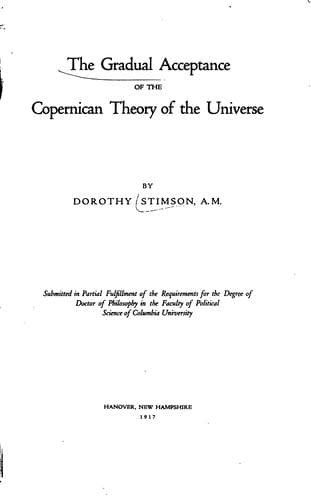
The gradual acceptance of the Copernican theory of the universe — John Shaqi
The gradual acceptance of the Copernican theory of the universeStimson, Dorothy
History
The gradual acceptance of the Copernican theory of the universe
Stimson, Dorothy
Astronomy -- History; Copernicus, Nicolaus, 1473-1543; Solar system
Quite otherwise was the situation in the sixteenth century at the
University of Salamanca. A new set of regulations for the University,
drawn up at the King's order by Bishop Covarrubias, was published in
1561. It contained the provision in the curriculum that "Mathematics
and Astrology are to be given in three years, the first, Astrology,
the second, Euclid, Ptolemy or Copernicus _ad vota audientium_," which
also indicates, as Vicente de la Fuente points out, that at this
University "the choice of the subject-matter to be taught lay not with
the teachers but with the students, a rare situation."[194] One
wonders what happened there when the professors and students received
word[195] from the Cardinal Nuncio at Madrid in 1633 that the
Congregations of the Index had decreed the Copernican doctrine was
thereafter in no way to be held, taught or defended.
[Footnote 194: La Fuente: _Historia de la Universidades ... de
España_: II, 314.]
[Footnote 195: _Doc. 86_ in Favaro: 130.]
One of the graduates of this University, Father Zuñiga,[196] (better
known as Didacus à Stunica), wrote a commentary on Job that was
licensed to be printed in 1579, but was not published until 1584 at
Toledo. Another edition appeared at Rome seven years later. It
evidently was widely read for it was condemned _donec corrigatur_ by
the Index in 1616 and the mathematical literature of the next half
century contains many allusions to his remarks on Job: IX: 6; "Who
shaketh the earth out of her place, and the pillars thereof tremble."
After commenting here upon the greater clarity and simplicity of the
Copernican theory, Didacus à Stunica then states that the theory is
not contradicted by Solomon in Ecclesiastes, as that "text signifieth
no more but this, that although the succession of ages, and
generations of men on earth be various, yet the earth itself is still
one and the same, and continueth without any sensible variation" ...
and "it hath no coherence with its context (as Philosophers show) if
it be expounded to speak of the earth's immobility. The motion that
belongs to the earth by way of speech is assigned to the sun even by
Copernicus himself, and those who are his followers.... To conclude,
no place can be produced out of Holy Scriptures which so clearly
speaks the earth's immobility as this doth its mobility. Therefore
this text of which we have spoken is easily reconciled to this
opinion. And to set forth the wonderful power and wisdom of God who
can indue the frame of the whole earth (it being of monstrous weight
by nature) with motion, this our Divine pen-man added; 'And the
pillars thereof tremble:' As if he would teach us, from the doctrine
laid down, that it is moved from its foundations."[197]
[Footnote 196: _Diccionario Enciclopédico Hispano-Americano de
literatura, ciencias y artes_ (Barcelona, 1898).]
Public-domain text, read in full here on John Shaqi.
Reviews
Reviews
No reviews yet
Be the first to share your thoughts on this work.
Join the Discussion
Join the discussion
Sign in to leave a comment or review.
Sign InorCreate an account