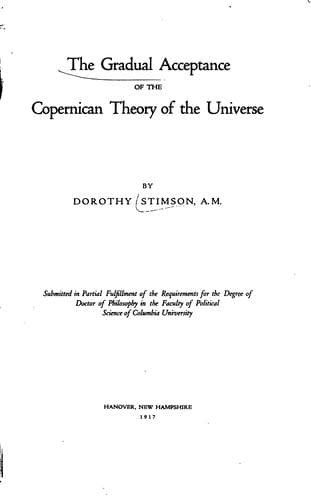
The gradual acceptance of the Copernican theory of the universeStimson, Dorothy
History
The gradual acceptance of the Copernican theory of the universe
Stimson, Dorothy
Astronomy -- History; Copernicus, Nicolaus, 1473-1543; Solar system
"MYS.: You argue subtly indeed, but in truth this argument
does not seem necessary to me; for what Aristotle admitted,
that, while forsooth all the parts of the firmament changed
their places, the firmament as a whole did not, is
exceedingly absurd. For either the whole heaven is at rest
or the whole heaven is moved. The senses themselves disprove
that it is at rest; therefore it is moved. For it does not
follow that if a body is not moved away from its place, it
is not moved in that place. Furthermore, since we have the
most certain proof of the movement of trepidation, not only
all the parts of the firmament, but also the eight spheres,
must necessarily leave their places and move up and down,
forward and back."[202]
[Footnote 198: Montaigne: _Essays_: Bk. II, c. 2: _An Apologie of
Raymonde Sebonde_ (II, 352).]
[Footnote 199: This book, published at Frankfort in 1597, was
translated into French by M. Fougerolles and printed in Lyons that
same year. It has become extremely rare since its "atheistic
atmosphere" (Peignot: _Dictionnaire_) caused the Roman Church to place
it upon the Index by decree of 1628, where it has remained to this
day.]
[Footnote 200: Cromer in History of Poland.]
[Footnote 201: Cromer in History of Poland.[A]]
[Footnote A: I could not find this reference in either of Martin
Kromer's books; _De Origine et Rebus Gestis Polonorum, ad 1511_, or in
his _Res Publicæ sive Status Regni Poloniæ_.]
[Footnote 202: Bodin: _Univ. Nat. Theatrum_: Bk. V, sec. 2 (end).]
This was the opinion of a profound thinker and experienced man of
affairs living when Tycho Brahe and Bruno were still alive and Kepler
and Galileo were beginning their astronomical investigations. But he
was not alone in his views, as we shall see; for at the close of the
sixteenth century, the Copernican doctrine had few avowed supporters.
The Roman Church was still indifferent; the Protestants clinging to
the literal interpretation of the Bible were openly antagonistic; the
professors as a whole were too Aristotelian to accept or pay much
attention to this novelty, except Kepler and his teacher Mæstlin
(though the latter refused to uphold it in his textbook);[203] while
astronomers and mathematicians who realized the insuperable objections
to the Ptolemaic conception, welcomed the Tychonic system as a _via
media_; and the common folk, if they heard of it at all, must have
ridiculed it because it was so plainly opposed to what they saw in the
heavens every day. In the same way their intellectual superiors
exclaimed at the "delirium" of those supporting such a notion.[204]
One thinker, however was to see far more in the doctrine than
Copernicus himself had conceived, and by Giordano Bruno the Roman
Church was to be aroused.
[Footnote 203: Delambre: _Astr. Mod._: I, 663.]
Public-domain text, read in full here on John Shaqi.
Reviews
Reviews
No reviews yet
Be the first to share your thoughts on this work.
Join the Discussion
Join the discussion
Sign in to leave a comment or review.
Sign InorCreate an account