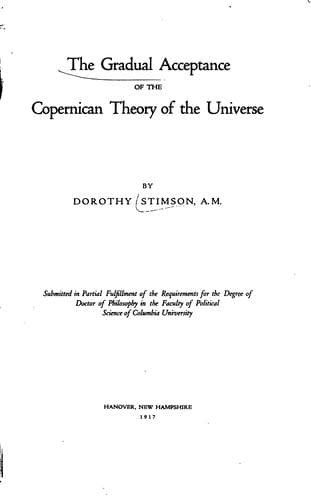
The gradual acceptance of the Copernican theory of the universeStimson, Dorothy
History
The gradual acceptance of the Copernican theory of the universe
Stimson, Dorothy
Astronomy -- History; Copernicus, Nicolaus, 1473-1543; Solar system
[Footnote 204: Justus-Lipsius: _Physiologiæ Stoicorum_: Bk. II,
dissert. 19 (Dedication 1604, Louvain), (IV, 947); "Vides deliria,
quomodo aliter appellent?"]
CHAPTER II.
BRUNO AND GALILEO.
When the Roman Catholic authorities awoke to the dangers of the new
teaching, they struck with force. The first to suffer was the famous
monk-philosopher, Giordano Bruno, whose trial by the Holy Office was
premonitory of trouble to come for Galileo.[205]
[Footnote 205: Berti: 285.]
After an elementary education at Naples near his birth-place,
Nola,[206] Filippo Bruno[207] entered the Dominican monastery in 1562
or 1563 when about fourteen years old, assuming the name Giordano at
that time. Before 1572, when he entered the priesthood, he had fully
accepted the Copernican theory which later became the basis of all his
philosophical thought. Bruno soon showed he was not made for the
monastic life. Various processes were started against him, and fleeing
to Rome he abandoned his monk's garments and entered upon the sixteen
years of wandering over Europe, a peripatetic teacher of the
philosophy of an infinite universe as deduced from the Copernican
doctrine and thus in a way its herald.[208] He reached Geneva in 1579
(where he did not accept Calvinism as was formerly thought),[209] but
decided before many months had passed that it was wise to depart
elsewhere because of the unpleasant position in which he found himself
there. He had been brought before the Council for printing invectives
against one of the professors, pointing out some twenty of his
errors. The Council sent him to the Consistory, the governing body of
the church, where a formal sentence of excommunication was passed
against him. When he apologized it was withdrawn. Probably a certain
stigma remained, and he left Geneva soon thereafter with a warm
dislike for Calvinism. After lecturing at the University of Toulouse
he appeared in Paris in 1581, where he held an extraordinary
readership. Two years later he was in England, for he lectured at
Oxford during the spring months and defended the Copernican theory
before the Polish prince Alasco during the latter's visit there in
June.[210]
[Footnote 206: McIntyre: 3-15.]
[Footnote 207: Four lives of Bruno have been written within the last
seventy-five years. The first is _Jordano Bruno_ by Christian
Bartholmèss (2 vol., Paris 1846). The next, _Vita di Giordano Bruno da
Nola_ by Domenico Berti (1868, Turin), quotes in full the official
documents of his trial. Frith's _Life of Giordano Bruno_ (London,
1887), has been rendered out of date by J.L. McIntyre's _Giordano
Bruno_ (London, 1903), which includes a critical bibliography. In
addition, W.R. Thayer's _Throne Makers_ (New York, 1899), gives
translations of Bruno's confessions to the Venetian Inquisition.
Bruno's Latin works (_Opera Latina Conscripta_), have been republished
by Fiorentino (3 vol., Naples, 1879), and the _Opere Italiane_ by
Gentile (3 vol., Naples, 1907).]
Public-domain text, read in full here on John Shaqi.
Reviews
Reviews
No reviews yet
Be the first to share your thoughts on this work.
Join the Discussion
Join the discussion
Sign in to leave a comment or review.
Sign InorCreate an account