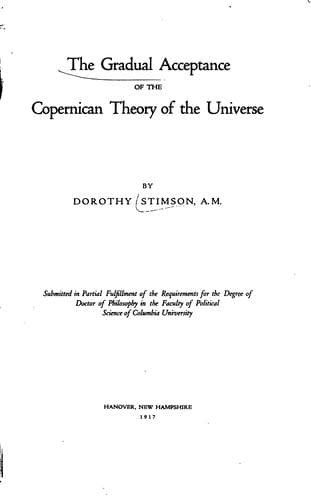
The gradual acceptance of the Copernican theory of the universeStimson, Dorothy
History
The gradual acceptance of the Copernican theory of the universe
Stimson, Dorothy
Astronomy -- History; Copernicus, Nicolaus, 1473-1543; Solar system
The Roman Inquisition was not content to let the Venetian court deal
with this arch heretic, but wrote in September, 1592, demanding his
extradition. The Venetian body referred its consent to the state for
ratification which the Doge and Council refused to grant. Finally,
when the Papal Nuncio had represented that Bruno was not a Venetian
but a Neapolitan, and that cases against him were still outstanding
both in Naples and in Rome, the state consented, and in February of
the next year, Bruno entered Rome, a prisoner of the Inquisition.
Nothing further is known about him until the Congregations took up his
case on February 4th, 1599. Perhaps Pope Clement had hoped to win back
to the true faith this prince of heretics.[225] However Bruno stood
firm, and early in the following year he was degraded, sentenced and
handed over to the secular authorities, who burned him at the stake in
the Campo di Fiori, February 17, 1600.[226] All his books were put on
the Index by decree of February 8, 1600, (where they remain to this
day), and as a consequence they became extremely rare. It is well to
remember Bruno's fate, when considering Galileo's case, for
Galileo[227] was at that time professor of mathematics in the
university of Padua and fully cognizant of the event.
[Footnote 225: Fahie: 82-89.]
[Footnote 226: Thayer: 299.]
[Footnote 227: The publication of A. Favaro's _Galileo e
l'Inquisizione: Documenti del Processo Galileiano ... per la prima
volta integralmente pubblicati_, (Firenze, 1907), together with that
of the National Edition (in 20 vols.) of Galileo's works, edited by
Favaro (Firenze, completed 1909), renders somewhat obsolete all
earlier lives of Galileo. The more valuable, however, of these books
are: Martin's _Galilée_ (Paris, 1868), a scholarly Catholic study
containing valuable bibliographical notes; Anon. (Mrs. Olney):
_Private Life of Galileo_, based largely on his correspondence with
his daughter from which many extracts are given; and von Gebler's
_Galileo Galilei and the Roman Curia_ (trans. by Mrs. Sturge, London,
1879), which includes in the appendix the various decrees in the
original. Fahie's _Life of Galileo_ (London, 1903), is based on
Favaro's researches and is reliable. The documents of the trial have
been published in part by de l'Epinois, von Gebler and Berti, but
Favaro's is the complete and authoritative edition.]
Public-domain text, read in full here on John Shaqi.
Reviews
Reviews
No reviews yet
Be the first to share your thoughts on this work.
Join the Discussion
Join the discussion
Sign in to leave a comment or review.
Sign InorCreate an account