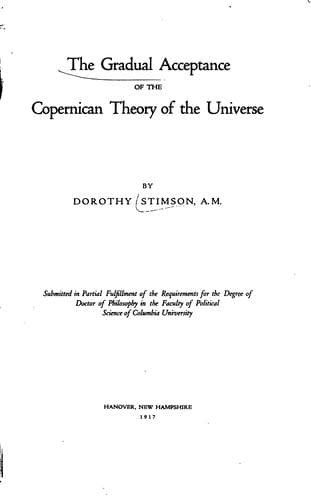
The gradual acceptance of the Copernican theory of the universe — John Shaqi
The gradual acceptance of the Copernican theory of the universeStimson, Dorothy
History
The gradual acceptance of the Copernican theory of the universe
Stimson, Dorothy
Astronomy -- History; Copernicus, Nicolaus, 1473-1543; Solar system
Galileo's father, though himself a skilled mathematician, had
intended that his son (born at Pisa, February 15, 1564), should be a
cloth-dealer, but at length permitted him to study medicine instead at
the university of Pisa, after an elementary education at the monastery
of Vallombrosa near Florence. At the Tuscan Court in Pisa, Galileo
received his first lesson in mathematics, which thereupon became his
absorbing interest. After nearly four years he withdrew from the
university to Florence and devoted himself to that science and to
physics. His services as a professor at this time were refused by five
of the Italian universities; finally, in 1589, he obtained the
appointment to the chair of physics at Pisa. He became so unpopular
there, however, through his attacks on the Aristotelian physics of the
day, that after three years he resigned and accepted a similar
position at Padua.[228] He remained here nearly eighteen years till
his longing for leisure in which to pursue his researches, and the
patronage of his good friend, the Grand Duke of Tuscany, brought him a
professorship at the university of Pisa again, this time without
obligation of residence nor of lecturing. He took up his residence in
Florence in 1610; and later (1626), purchased a villa at Arcetri
outside the city, in order to be near the convent where his favorite
daughter "Suor Maria Celeste" was a religious.[229]
[Footnote 228: Fahie: 20-40.]
[Footnote 229: Ibid: 121.]
During the greater part of his lectureship at Padua, Galileo taught
according to the Ptolemaic cosmogony out of compliance with popular
feeling, though himself a Copernican. In a letter to Kepler (August 4,
1597)[230] he speaks of his entire acceptance of the new system for
some years; but not until after the appearance of the New Star in the
heavens in 1604 and 1605, and the controversy that its appearance
aroused over the Aristotelian notion of the perfect and unchangeable
heavens, did he publicly repudiate the old scheme and teach the new.
The only information we have as to how he came to adopt the Copernican
scheme for himself is the account given by "_Sagredo_," Galileo's
spokesman in the famous _Dialogue on the Two Principal Systems_
(1632):
Public-domain text, read in full here on John Shaqi.
Reviews
Reviews
No reviews yet
Be the first to share your thoughts on this work.
Join the Discussion
Join the discussion
Sign in to leave a comment or review.
Sign InorCreate an account