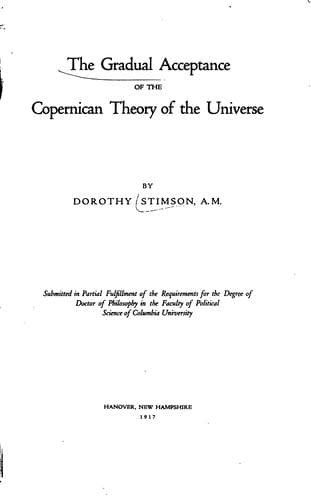
The gradual acceptance of the Copernican theory of the universe — John Shaqi
The gradual acceptance of the Copernican theory of the universeStimson, Dorothy
History
The gradual acceptance of the Copernican theory of the universe
Stimson, Dorothy
Astronomy -- History; Copernicus, Nicolaus, 1473-1543; Solar system
curious to dive, as they say, into the bottom of this
business ... and bring myself to a certainty in this
subject."[231]
[Footnote 230: Galileo: _Opere_, X, 68.]
[Footnote 231: 'The Second Day' in Salusbury: _Math. Coll._ I,
110-111.]
Galileo's brilliant work in mechanics and his great popularity--for
his lectures were thronged--combined with his skilled and witty
attacks upon the accepted scientific ideas of the age, embittered and
antagonized many who were both conservative and jealous.[232] The
Jesuits particularly resented his influence and power, for they
claimed the leadership in the educational world and were jealous of
intruders. Furthermore, they were bound by the decree of the fiftieth
General Congregation of their society in 1593 to defend Aristotle, a
decree strictly enforced.[233] While a few of the Jesuits were
friendly disposed to Galileo at first, the controversies in which he
and they became involved and their bitter attacks upon him made him
feel by 1633 that they were among his chief enemies.[234]
[Footnote 232: Fahie: 265.]
[Footnote 233: Conway: 46-47.]
[Footnote 234: Conway: 46-47.]
Early in 1609, Galileo heard a rumor of a spy-glass having been made
in Flanders, and proceeded to work one out for himself according to
the laws of perspective. The fifth telescope that he made magnified
thirty diameters, and it was with such instruments of his own
manufacture that he made in the next three years his famous
discoveries: Jupiter's four satellites (which he named the Medicean
Planets), Saturn's "tripartite" character (the rings were not
recognized as such for several decades thereafter), the stars of the
Milky Way, the crescent form of Venus, the mountains of the moon, many
more fixed stars, and the spots on the sun. Popular interest waxed
with each new discovery and from all sides came requests for
telescopes; yet there were those who absolutely refused even to look
through a telescope lest they be compelled to admit Aristotle was
mistaken, and others claimed that Jupiter's moons were merely defects
in the instrument. The formal announcement of the first of these
discoveries was made in the _Sidereus Nuncius_ (1610), a book that
aroused no little opposition. Kepler, however, had it reprinted at
once in Prague with a long appreciative preface of his own.[235]
[Footnote 235: Fahie: 77-126.]
The following March Galileo went to Rome to show his discoveries and
was received with the utmost distinction by princes and church
dignitaries alike. A commission of four scientific members of the
Roman College had previously examined his claims at Cardinal
Bellarmin's suggestion, and had admitted their truth. Now Pope Paul V
gave him long audiences; the Academia dei Lincei elected him a member,
and everywhere he was acclaimed. Nevertheless his name appears on the
secret books of the Holy Office as early as May of that year
(1611).[236] Already he was a suspect.
[Footnote 236: Doc. in Favaro: 13.]
Public-domain text, read in full here on John Shaqi.
Reviews
Reviews
No reviews yet
Be the first to share your thoughts on this work.
Join the Discussion
Join the discussion
Sign in to leave a comment or review.
Sign InorCreate an account