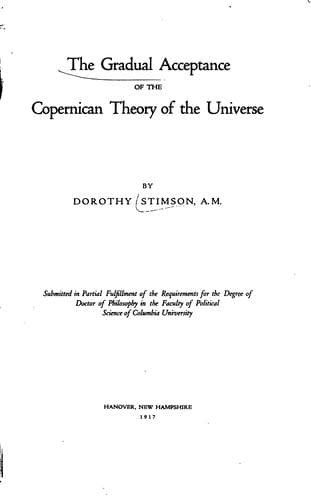
The gradual acceptance of the Copernican theory of the universe — John Shaqi
The gradual acceptance of the Copernican theory of the universeStimson, Dorothy
History
The gradual acceptance of the Copernican theory of the universe
Stimson, Dorothy
Astronomy -- History; Copernicus, Nicolaus, 1473-1543; Solar system
Among the philosophers were some noted as mathematicians whose leader
was Pythagoras (c. 550 B.C.). He and at least one of the members of
his school, Eudoxus (409?-356? B.C.), had visited Egypt, according to
Diogenes Laërtius,[9] and had in all probability been much interested
in and influenced by the astronomical observations made by the
Egyptian priests. On the same authority, Pythagoras was the first to
declare the earth was round and to discuss the antipodes. He too
emphasized the beauty and perfection of the circle and of the sphere
in geometry, forms which became fixed for 2000 years as the fittest
representations of the perfection of the heavenly bodies.
[Footnote 9: Diogenes Laërtius: _De Vitis_, Lib. VIII, c. 1, et 8
(205, 225).]
There was some discussion in Diogenes' time as to the author of the
theory of the earth's motion of axial rotation. Diogenes[10] gives the
honor to Philolaus (5th cent. B.C.) one of the Pythagoreans, though he
adds that others attribute it to Icetas of Syracuse (6th or 5th cent.
B.C.). Cicero, however, states[11] the position of Hicetas of Syracuse
as a belief in the absolute fixedness of all the heavenly bodies
except the earth, which alone moves in the whole universe, and that
its rapid revolutions upon its own axis cause the heavens apparently
to move and the earth to stand still.
[Footnote 10: Diogenes: _Op. cit._, Lib. VIII, c. 7 (225).]
[Footnote 11: Cicero: _Academica_, Lib. II, c. 39 (322).]
Other thinkers of Syracuse may also have felt the Egyptian influence;
for one of the greatest of them, Archimedes (c. 287-212 B.C.), stated
the theory of the earth's revolution around the sun as enunciated by
Aristarchus of Samos. (Perhaps this is the "hearth-fire of the
universe" around which Philolaus imagined the earth to whirl.[12]) In
_Arenarius_, a curious study on the possibility of expressing infinite
sums by numerical denominations as in counting the sands of the
universe, Archimedes writes:[13] "For you have known that the universe
is called a sphere by several astrologers, its center the center of
the earth, and its radius equal to a line drawn from the center of the
sun to the center of the earth. This was written for the unlearned, as
you have known from the astrologers.... [Aristarchus of Samos][14]
concludes that the world is many times greater than the estimate we
have just given. He supposes that the fixed stars and the sun remain
motionless, but that the earth following a circular course, revolves
around the sun as a center, and that the sphere of the fixed stars
having the same sun as a center, is so vast that the circle which he
supposes the earth to follow in revolving holds the same ratio to the
distance of the fixed stars as the center of a sphere holds to its
circumference."
[Footnote 12: Plutarch: _Op. cit._, Lib. II (V. 299-300).]
[Footnote 13: Archimedes: _Arenarius_, c. 1. Delambre: _Astr. Anc._,
I, 102.]
Public-domain text, read in full here on John Shaqi.
Reviews
Reviews
No reviews yet
Be the first to share your thoughts on this work.
Join the Discussion
Join the discussion
Sign in to leave a comment or review.
Sign InorCreate an account