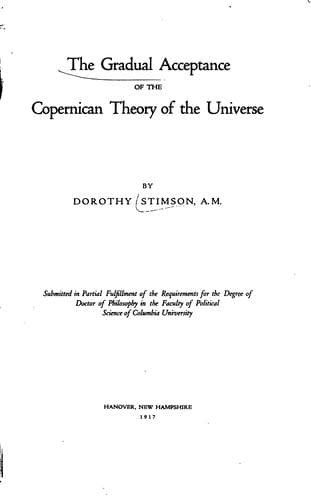
The gradual acceptance of the Copernican theory of the universe — John Shaqi
The gradual acceptance of the Copernican theory of the universeStimson, Dorothy
History
The gradual acceptance of the Copernican theory of the universe
Stimson, Dorothy
Astronomy -- History; Copernicus, Nicolaus, 1473-1543; Solar system
[Footnote 14: This is the only account of his system. Even the age in
which he flourished is so little known that there have been many
disputes whether he was the original inventor of this system or
followed some other. He was probably a contemporary of Cleanthes the
Stoic in the 3rd century B.C. He is mentioned also by Ptolemy,
Diogenes Laërtius and Vitruvius. (Schiaparelli: _Die Vorlaufer des
Copernicus im Alterthum_, 75. See also Heath: _Op. cit._)]
These ancient philosophers realized in some degree the immensity of
the universe in which the earth was but a point. They held that the
earth was an unsupported sphere the size of which Eratosthenes (c.
276-194 B.C.) had calculated approximately. They knew the sun was far
larger than the earth, and Cicero with other thinkers recognized the
insignificance of earthly affairs in the face of such cosmic
immensity. They knew too about the seven planets, had studied their
orbits, and worked out astronomical ways of measuring the passage of
time with a fair amount of accuracy. Hipparchus and other thinkers had
discovered the fact of the precession of the equinoxes, though there
was no adequate theory to account for it until Copernicus formulated
his "motion of declination." The Pythagoreans accepted the idea of the
earth's turning upon its axis, and some even held the idea of its
revolution around the motionless sun. Others suggested that comets had
orbits which they uniformly followed and therefore their reappearance
could be anticipated.[15]
[Footnote 15: Plutarch: _Op. cit._: Bk. III, c. 2 (V, 317-318).]
Why then was the heliocentric theory not definitely accepted?
In the first place, such a theory was contrary to the supposed facts
of daily existence. A man did not have to be trained in the schools to
observe that the earth seemed stable under his feet and that each
morning the sun swept from the east to set at night in the west.
Sometimes it rose more to the north or to the south than at other
times. How could that be explained if the sun were stationary?
Study of the stars was valuable for navigators and for surveyors,
perhaps, but such disturbing theories should not be propounded by
philosophers. Cleanthes,[16] according to Plutarch,[17] "advised that
the Greeks ought to have prosecuted Aristarchus the Samian for
blasphemy against religion, as shaking the very foundations of the
world, because this man endeavoring to save appearances, supposed that
the heavens remained immovable and that the earth moved through an
oblique circle, at the same time turning about its own axis." Few
would care to face their fellows as blasphemers and impious thinkers
on behalf of an unsupported theory. Eighteen hundred years later
Galileo would not do so, even though in his day the theory was by no
means unsupported by observation.
[Footnote 16: The Stoic contemporary of Aristarchus, author of the
famous Stoic hymn. See Diogenes Laërtius: _De Vitis_.]
Public-domain text, read in full here on John Shaqi.
Reviews
Reviews
No reviews yet
Be the first to share your thoughts on this work.
Join the Discussion
Join the discussion
Sign in to leave a comment or review.
Sign InorCreate an account