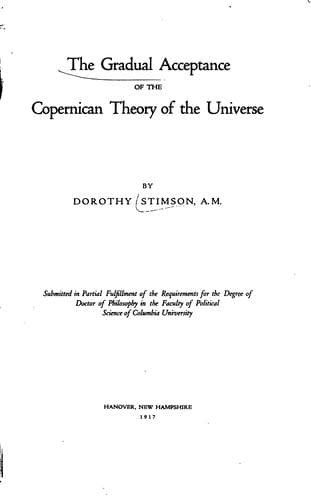
The gradual acceptance of the Copernican theory of the universeStimson, Dorothy
History
The gradual acceptance of the Copernican theory of the universe
Stimson, Dorothy
Astronomy -- History; Copernicus, Nicolaus, 1473-1543; Solar system
Ptolemy devotes a column or two of his _Almagest_[22] (to use the
familiar Arabic name for his _Syntaxis Mathematica_) to the refutation
of the heliocentric theory, thereby preserving it for later ages to
ponder on and for a Copernicus to develop. He admits at the outset
that such a theory is only tenable for the stars and their phenomena,
and he gives at least three reasons why it is ridiculous. If the earth
were not at the center, the observed facts of the seasons and of day
and night would be disturbed and even upset. If the earth moves, its
vastly greater mass would gain in speed upon other bodies, and soon
animals and other lighter bodies would be left behind unsupported in
the air--a notion "ridiculous to the last degree," as he comments,
"even to imagine it." Lastly, if it moves, it would have such
tremendous velocity that stones or arrows shot straight up in the air
must fall to the ground east of their starting point,--a "laughable
supposition" indeed to Ptolemy.
[Footnote 22: Ptolemy: _Almagest_, Lib. I, c. 7, (1, 21-25).
Translated in Appendix B.]
This book became the great text of the Middle Ages; its author's name
was given to the geocentric theory it maintained. Astronomy for a
thousand years was valuable only to determine the time of Easter and
other festivals of the Church, and to serve as a basis for astrology
for the mystery-loving people of Europe.
To the Arabians in Syria and in Spain belongs the credit of preserving
for Europe during this long period the astronomical works of the
Greeks, to which they added their own valuable observations of the
heavens--valuable because made with greater skill and better
instruments,[23] and because with these observations later scientists
could illustrate the permanence or the variability of important
elements. They also discovered the so-called "trepidation" or apparent
shifting of the fixed stars to explain which they added another sphere
to Ptolemy's eight. Early in the sixth century Uranus translated
Aristotle's works into Syrian, and this later was translated into
Arabic.[24] Albategnius[25] (c. 850-829 [Transcriber's Note: 929]
A.D.), the Arabian prince who was the greatest of all their
astronomers, made his observations from Aracte and Damascus, checking
up and in some cases amending Ptolemy's results.[26]
[Footnote 23: Whewell: I, 239.]
[Footnote 24: Whewell: I, 294.]
[Footnote 25: Berry: 79.]
[Footnote 26: His book _De Motu Stellarum_, translated into Latin by
Plato Tiburtinus (fl. 1116) was published at Nuremberg (1557) by
Melancthon with annotations by Regiomontanus. _Ency. Brit._ 11th.
Edit.]
Public-domain text, read in full here on John Shaqi.
Reviews
Reviews
No reviews yet
Be the first to share your thoughts on this work.
Join the Discussion
Join the discussion
Sign in to leave a comment or review.
Sign InorCreate an account