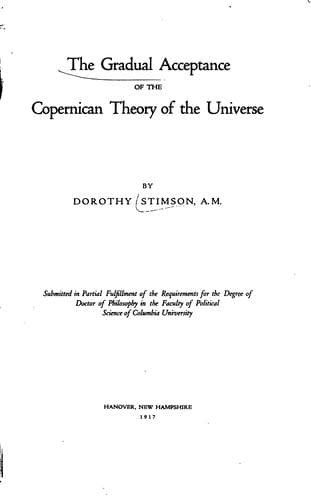
The gradual acceptance of the Copernican theory of the universeStimson, Dorothy
History
The gradual acceptance of the Copernican theory of the universe
Stimson, Dorothy
Astronomy -- History; Copernicus, Nicolaus, 1473-1543; Solar system
Then the center of astronomical development shifted from Syria to
Spain and mainly through this channel passed on into Western Europe.
The scientific fame of Alphonse X of Castile (1252-1284 A.D.) called
the Wise, rests chiefly upon his encouragement of astronomy. With his
support the Alfonsine Tables were calculated. He is said[27] to have
summoned fifty learned men from Toledo, Cordova and Paris to translate
into Spanish the works of Ptolemy and other philosophers. Under his
patronage the University of Salamanca developed rapidly to become
within two hundred years one of the four great universities of
Europe[28]--a center for students from all over Europe and the
headquarters for new thought, where Columbus was sheltered,[29] and
later the Copernican system was accepted and publicly taught at a time
when Galileo's views were suppressed.[30]
[Footnote 27: Vaughan: I, 281.]
[Footnote 28: Graux: 318.]
[Footnote 29: Graux: 319.]
[Footnote 30: Rashdall: II, pt. I, 77.]
Popular interest in astronomy was evidently aroused, for Sacrobosco
(to give John Holywood[31] his better known Latin name) a Scotch
professor at the Sorbonne in Paris in the 13th century, published a
small treatise _De Sphæri Mundo_ that was immensely popular for
centuries,[32] though it was practically only an abstract of the
_Almagest_. Whewell[33] tells of a French poem of the time of Edward I
entitled _Ymage du Monde_, which gave the Ptolemaic view and was
illustrated in the manuscript in the University of Cambridge with a
picture of the spherical earth with men upright on it at every point,
dropping balls down perforations in the earth to illustrate the
tendency of all things toward the center. Of the same period (13th
century) is an Arabian compilation in which there is a reference to
another work, the book of Hammarmunah the Old, stating that "the earth
turns upon itself in the form of a circle, and that some are on top,
the others below ... and there are countries in which it is constantly
day or in which at least the night continues only some instants."[34]
Apparently, however, such advanced views were of no influence, and the
Ptolemaic theory remained unshaken down to the close of the 15th
century.
[Footnote 31: _Dict. of Nat. Biog._]
[Footnote 32: MSS. of it are extremely numerous. It was the second
astronomical book to be printed, the first edition appearing at
Ferrara in 1472. 65 editions appeared before 1647. It was translated
into Italian, French, German, and Spanish, and had many commentators.
_Dict. of Nat. Biog._]
[Footnote 33: Whewell: I, 277.]
[Footnote 34: Blavatski: II, 29, note.]
Public-domain text, read in full here on John Shaqi.
Reviews
Reviews
No reviews yet
Be the first to share your thoughts on this work.
Join the Discussion
Join the discussion
Sign in to leave a comment or review.
Sign InorCreate an account