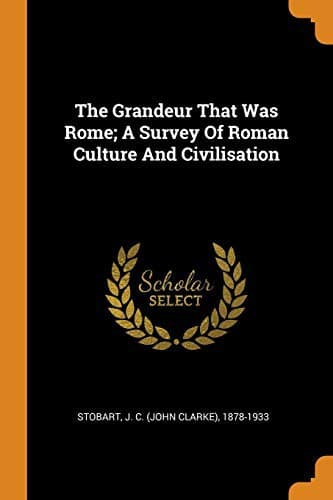
The Grandeur That Was Rome: a survey of Roman culture and civilisation — John Shaqi
The Grandeur That Was Rome: a survey of Roman culture and civilisationStobart, J. C. (John Clarke)
History
The Grandeur That Was Rome: a survey of Roman culture and civilisation
Stobart, J. C. (John Clarke)
Rome -- Civilization; Rome -- History
But there is, it appears, a widely prevalent false perspective in the
common view of Roman history. The modern reader, especially if he
be an Englishman, is a very stern moralist in his judgment of other
nations and ages. In addition to this he is a citizen of an empire now
extremely self-conscious and somewhat bewildered at its own magnitude.
He cannot help drawing analogies from Roman history and seeking in it
“morals” for his own guidance. The Roman empire bears such an obvious
and unique resemblance to the British that the fate of the former
must be of enormous interest to the latter. For this reason alone we
are apt to regard the _fall_ of Rome as the cardinal point of Roman
history. To this must be added the influence of Gibbon’s great work.
By Gibbon we are led to contemplate above all things (with Silas Wegg)
her Decline and Fall. Thus Rome has become for many people simply
a colossal failure and a horrible warning. We behold her first as
a Republic tottering to her inevitable ruin, and then as an Empire
decaying from the start and continuing to fester for some five hundred
years. This is one of the cases which prove that History is made not so
much by heroes or natural forces as by historians. It is an accident of
historiography that the Republic was not described by any great native
historian until its close, when amid the horrors of civil war men set
themselves to idealise the heroes of extreme antiquity and thus left
a gloomy picture of unmitigated deterioration. As there was no great
historian in sympathy with the imperial regime, the reputation of the
early Empire was left mainly in the hands of Tacitus and Suetonius, the
former of whom riddled it with epigrams while the latter befouled it
with scandal. Nearly all Roman writers had a rhetorical training and a
satirical bent: all Romans were praisers of the past. Thus it is that
Roman virtue has receded into an age which modern criticism declares
to be mythological. It is a further accident that the genius of Rome’s
greatest modern historian was also strongly satirical. It was a natural
affinity of temper which led Gibbon to continue the story of Tacitus
and to dip his pen into the same bitter fluid.
Public-domain text, read in full here on John Shaqi.
Reviews
Reviews
No reviews yet
Be the first to share your thoughts on this work.
Join the Discussion
Join the discussion
Sign in to leave a comment or review.
Sign InorCreate an account