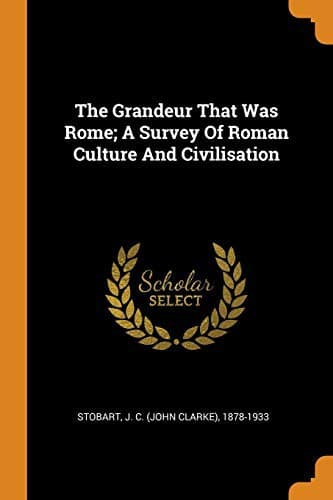
The Grandeur That Was Rome: a survey of Roman culture and civilisationStobart, J. C. (John Clarke)
History
The Grandeur That Was Rome: a survey of Roman culture and civilisation
Stobart, J. C. (John Clarke)
Rome -- Civilization; Rome -- History
Thus Rome has found few impartial historians and hardly any sympathetic
ones. But is it possible to be sympathetic? While every true scholar
feels a thrill at the name of Greece, scarcely any one _loves_ Ancient
Rome. At the first mention of her name the average man’s thoughts fly
to the Colosseum and the Christian martyr “facing the lion’s gory mane”
to the music of Nero’s fiddle. His second thought is to formulate his
explanation of her decline and fall. The explanations are as various
as political complexions. “Luxury,” says the moralist, “Heathendom,”
says the Christian, “Christianity,” replies Gibbon. The Protectionist
can easily show that it was due to the Importation of free corn, while
the Free Trader draws attention to the enormous burdens which Roman
trade had to bear. “Militarism,” explains the peace-lover; “neglect of
personal service,” replies the conscriptionist. The Liberal and the
Conservative can both draw valuable conclusions from Roman history in
support of their respective attitudes of mind. “If it had not been for
demagogues like Marius and the Gracchi,” says the Conservative, “Rome
might have continued to exhibit the courage and patriotism which
she displayed under senatorial guidance in the war against Hannibal,
instead of rushing to her doom by way of sedition and disorder.” With
equal justice the Liberal points to the stupid bigotry with which that
corrupt oligarchy, the senate, delayed necessary reforms. That, he
says, was the cause of the downfall of Rome. That was the writing on
the wall.
Whether it is or is not possible to love Ancient Rome, I would suggest
that this attitude of treating her merely as a subject for autopsies
and a source of gloomy vaticinations for the benefit of the British
Empire is a preposterous affront to history. The mere notion of an
empire continuing to decline and fall for five centuries is ridiculous.
It is to regard as a failure the greatest civilising force in all the
history of Europe, the most stable form of government, the strongest
military and political system that has ever existed.
It is just at this point that our own generation can add something of
great importance to the study of Roman history. Whatever may be said
for its faith, hope is the great discovery of our age. By the help of
that blessed word “Evolution” we have learnt not to put our Golden Ages
in the past but in the future. In many instances we have discovered
that what our fathers called decay was really progress. May it not be
so with Rome?
Public-domain text, read in full here on John Shaqi.
Reviews
Reviews
No reviews yet
Be the first to share your thoughts on this work.
Join the Discussion
Join the discussion
Sign in to leave a comment or review.
Sign InorCreate an account