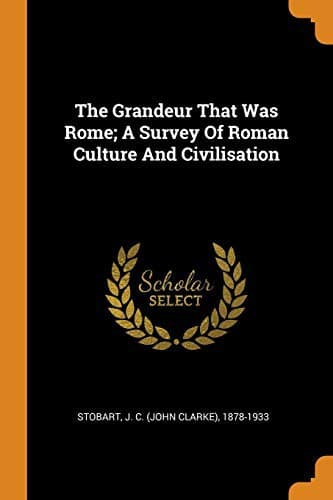
The Grandeur That Was Rome: a survey of Roman culture and civilisation — John Shaqi
The Grandeur That Was Rome: a survey of Roman culture and civilisationStobart, J. C. (John Clarke)
History
The Grandeur That Was Rome: a survey of Roman culture and civilisation
Stobart, J. C. (John Clarke)
Rome -- Civilization; Rome -- History
Hellenism we know and understand; every true classical scholar is
a Hellenist by conviction. But what is Latinism and who are our
Latinists? The altar fires are extinct and the votaries are scattered.
Except for a small volume of the choicest Latin poetry of the Augustan
age, what that is Latin gives us pleasure to-day? Greek studies seem
to attract all that is most brilliant and genial in the world of
scholarship: Latin is mainly relegated to the dry-as-dusts. Who reads
Lucan out of school hours? Who would search Egypt for Cicero’s lost
work “De Gloria”? Who would recognise a quotation from Statius?
It has not always been so. Once they quoted Lucan and Seneca across
the floor of the House of Commons. The eighteenth century was far more
in sympathy with Ancient Rome than we are. In those days it would not
have seemed absurd to argue the superiority of Vergil over Homer. Down
to that day Latin had remained the alternative language for educated
people, the medium of international communication, even for diplomacy,
until French gradually took its place. Only if you specifically sought
to reach the vulgar did you write in English. Though Dr. Johnson could
write a very pretty letter in French, he used habitually to converse
with Frenchmen in Latin; not that it made him more intelligible, for,
in fact, no foreigner could understand the English pronunciation of
Latin; but that he did not wish to appear at a disadvantage with a mere
Frenchman by adopting a foreign jargon. As for public inscriptions,
though half the literary men in London signed a round-robin entreating
the great autocrat to write Oliver Goldsmith’s epitaph in English,
Johnson “refused to disgrace the walls of Westminster Abbey with an
English inscription.”
Public-domain text, read in full here on John Shaqi.
Reviews
Reviews
No reviews yet
Be the first to share your thoughts on this work.
Join the Discussion
Join the discussion
Sign in to leave a comment or review.
Sign InorCreate an account