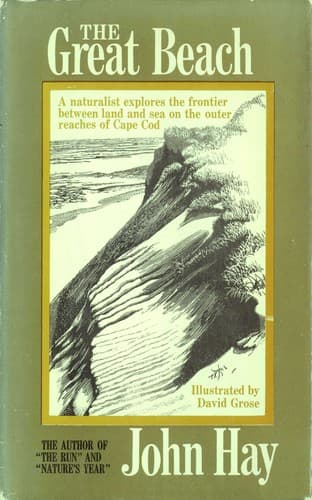
Cape Cod (Mass.) -- Description and travel; Natural history -- Massachusetts -- Cape Cod
XIV--The Marsh 116
XV--The Uses of Light 124
The
Great
Beach
I
From a Distance
The Pilgrims who reached Cape Cod in 1620 had heard of it before. It
got its name in 1602 and had been touched on by European seamen at
least a century before that, and so when the Pilgrims “... fell in with
that land which is called Cape Cod; the which being made and certainly
known to be it, they were not a little joyful.”
Their coming had taken a long time, and they had passed over “a tedious
and dreadful” sea; but as Bradford’s history relates it further: “...
they now had no friends to welcome them, nor inns to entertain or
refresh their weather-beaten bodies, no houses or much less towns to
repair to, to seek for succor.”
“And for ye season it was winter, and they that know ye winters of
that country know them to be sharp and violent, and subject to cruell
and fierce storms, dangerous to travel to known places, much more to
search an unknown coast. Besides, what could they see but a hideous
wilderness, full of wild beasts and wild men? and what multitudes there
might be of them they knew not. Neither could they, as it were, go up
to ye top of Pisgah, to view from this wilderness a more goodly country
to feed their hopes; for which way soever they turned their eyes (save
upward to the heavens) they could have little solace or content in
respect of outward objects. For summer being done, all things stand
upon them with a weather-beaten face; and the whole country, full of
woods and thickets, represented a wild and savage hue. If they looked
behind them, there was the mighty ocean which they had passed, and was
now as a main barrier and gulf to separate them from the civil parts of
the world.”
Now, nearly 350 years later, that lone land reaching out into the
mighty ocean seems to be full of the “solace and content with respect
to outward objects” which the Pilgrims lacked. Roads, gas stations,
shopping centers, and a continually increasing number of houses,
proclaim it as human territory, another populated home ground from
which we have to go far to be separated from civilization. The simple,
raw existence which the Pilgrims not only endured but anticipated has
been replaced by a world of goods, which is not to say that we do not
have to have a fortitude of our own, made inevitable, in great measure,
by the very abundance we have achieved.
Public-domain text, read in full here on John Shaqi.
Reviews
Reviews
No reviews yet
Be the first to share your thoughts on this work.
Join the Discussion
Join the discussion
Sign in to leave a comment or review.
Sign InorCreate an account