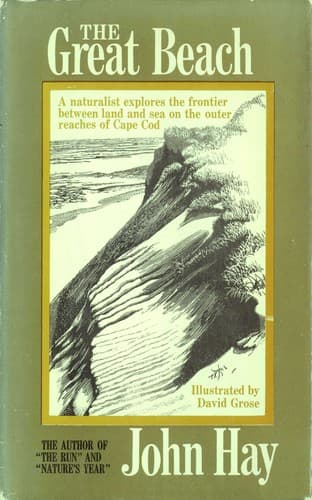
Cape Cod (Mass.) -- Description and travel; Natural history -- Massachusetts -- Cape Cod
The Cape Cod of 1620 was more or less the same in its general outline
as it is now, although the original woodland has been cut down, or
burned over, to be replaced by less varied trees, much of the topsoil
has eroded and blown away, and the shore line altered in the course
of natural change. Superficially at least, it has been tamed, and in
most areas the primal, unknown wildness is hard to imagine. The last
thing you would expect to find on pulling in to a parking lot above a
Cape Cod beach would be desolate wilderness, though if there is one,
wilderness being in short supply these days, it would be well worth the
effort to discover; but the sea, from which we are separated both by
its vastness and the difference between water and air, could answer the
description, and also the sands that define its limits.
Cape Cod’s Outer Beach, stretching for forty miles from the tip of the
Cape at Provincetown to the end of Monomoy Island is not undiscovered
country. Many men have walked it. Planes skim over it in no time at
all, and the beach buggies bruise it with impunity. Still, the marks we
make on it are all erased in time. The sea and sand insist on their
own art. The beach is in a continuous state of remaking and invites
discovery. It was first called “Great” so far as I know, by Henry David
Thoreau. Otherwise it has been known for a long time as the Outer
Beach, the Outer Shore, or in more familiar terms as the Back Side. Now
it forms a major part of the new National Seashore Park--in the process
of establishment--and is therefore not owned by individuals, or the
towns in which they reside, but by the people of the United States. It
is under national protection and possession at the same time, so how we
approach and treat its future is a very great responsibility, which is
appropriate enough.
The beach, standing out against the sea, is a further limit to America
before it shelves off into the Atlantic depths. For most travelers it
means the end of a highway, a place of summer sands. It is in fact one
end of a whole continent of roads, of communications, of the vast and
intricate business of human passage. In a sense it used to be the other
way around. With all the known parts of the civilized world behind
them, the Pilgrims found in this beach not an end but a beginning,
whatever it might entail, and that of course, is why they went there.
This is an age in which we are able to ignore or bypass the “tedious
and dreadful” highway of the sea--city dwellers, road, rocket, car, and
plane makers that we are--to the extent that we too may find it again
for the first time. The beach, lying by the sea and sea invested, is
always ready for a new kind of attention in a new world. That is the
nature of the place. Cape Cod itself, now and ultimately, is at the
disposition of the sea rather than human enterprise.
Public-domain text, read in full here on John Shaqi.
Reviews
Reviews
No reviews yet
Be the first to share your thoughts on this work.
Join the Discussion
Join the discussion
Sign in to leave a comment or review.
Sign InorCreate an account